




A Stretchable Tactile Sensor Array Based on Hydrogel Ionic Diodes
With the rapid rise of embodied artificial intelligence (AI) and robotics, robots are now not seen as cold, mechanical tools. They are expected to show advancement and live in the human world, sensing, responding, and adapting to its surroundings. One step toward that vision is to give robots an artificial skin, much like our own. Giving robots a skin-like interface would allow them to engage with their surroundings more delicately and intuitively through physical touch, or what we can say 'human touch'.
To realize such technology, the researchers must understand the anatomy and design of human skin. Unlike the rigid metallic shells of conventional robots, human skin is soft and stretchy. It feels external information, such as pressure, through the basic movement of ions beneath the surface. These ionic signals are the biological language, very different from the electronic signals running through machines.
At the small scale, the control of these ionic signals comes from synapses, where the movement of ions across membranes is precisely regulated, governing how electrical signals are transmitted between neurons. This behavior is similar to that of a diode. By mimicking this diode-like control in materials and devices, researchers can design the building blocks of artificial skin that sense and communicate using the same ionic principles as human skin.
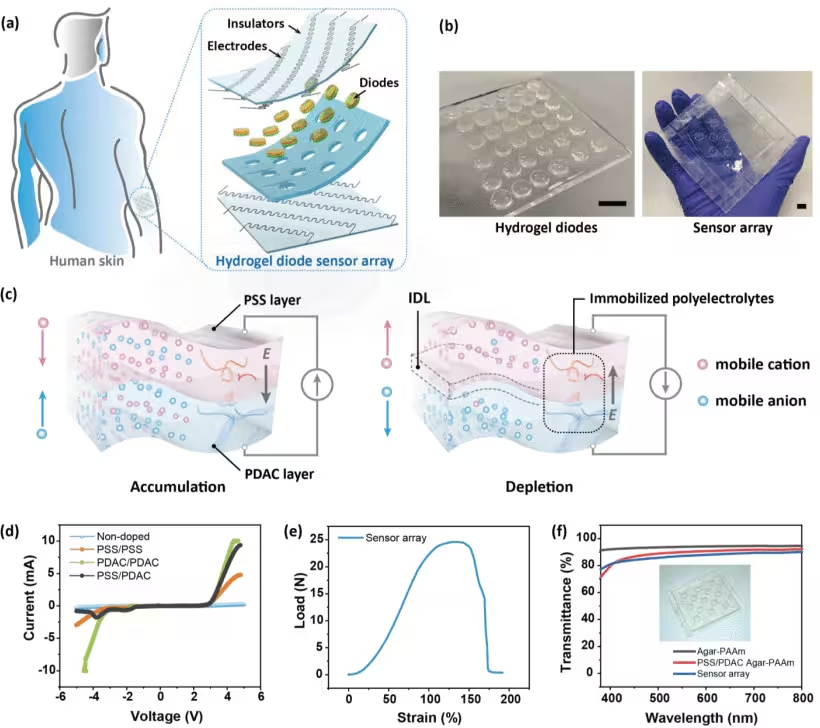
Here, the researchers developed a soft tactile sensor array composed of multiple ionic diode blocks. These diodes are not rigid electronic parts but water-rich gels that closely resemble living tissue. By combining positively and negatively charged polymers, soft materials were developed that behave like semiconductors for ions. Each diode functions much like a biological synapse, controlling the flow of ions. When these diodes are linked together in an array, a gentle touch alters ion transport within the material, turning physical contact into iontronic signals, thereby allowing the system to mimic how human skin senses and transmits tactile information.
The ionic diode array can read touch in multiple ways. Like many gels, it measures resistance and capacitance, as well as open-circuit voltage (OCV) and short-circuit current (SCC). When the array is touched or deformed, the ions within each diode rearrange themselves. This spontaneous ion movement produces OCV and SCC signals, enabling the device to function in a self-powered manner. All these abilities arise from the intrinsic ion-based diode design.
The researchers demonstrated the tactile sensor array in human-machine interaction scenarios, including a touch pad that could control a robotic hand and even play the classic Snake game. While electrons have long dominated traditional electronics and robotics, ions, which are abundant in nature and biology, may hold even greater promise for future iontronic systems. As the famous architect Zaha Hadid once said, “There are 360 degrees. Why stick to one?” Likewise, by embracing the rich palette of ions rather than relying on a single electron, the future may open new directions for soft robotics and intelligent materials as varied as life itself.