



A Stretchable, Skin-Adhesive FBG-Based Wearable Sensor for Human Health Monitoring: From Vital Signs to Biomechanical Activity
Wearable technologies and devices have transformed healthcare by enabling continuous monitoring of physiological signals. However, a major challenge lies in achieving high measurement accuracy while maintaining user comfort. Many flexible technologies can detect subtle signals, but they often require additional tapes, belts, or external adhesives to remain securely in place on the skin. Conversely, although self-adhesive systems can provide strong and stable skin attachment, they may not always ensure high sensing performance or long-term measurement reliability.
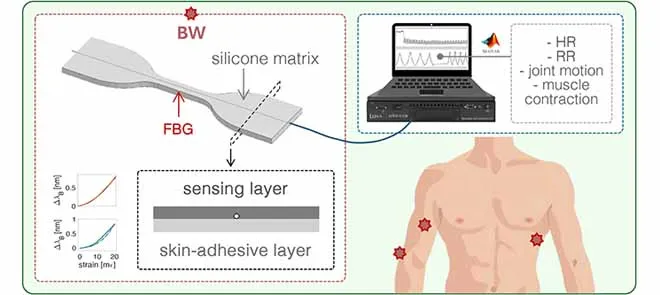
To address this challenge, the researchers have developed a stretchable, skin-adhesive wearable system based on a fiber Bragg grating (FBG) sensor. FBGs offer several advantages for wearable applications, including high strain sensitivity, fast response time, compact size, and immunity to electromagnetic interference. This innovative solution embeds an FBG within a dog-bone-shaped, soft, flexible bilayer silicone structure that can be attached directly to the skin. The top structural layer provides mechanical robustness and effective strain transfer, while the bottom layer provides intrinsic adhesion to the skin, making it suitable for human health monitoring. This configuration was designed to maintain accurate, reliable strain sensing while ensuring compactness and comfort.
The proposed device was extensively characterized to evaluate whether the FBG integration strategy would compromise its metrological performance and to assess the overall feasibility. The device exhibited a strain sensitivity of approximately 0.04 nm/µε, with high repeatability and low uncertainty. Cyclic mechanical testing conducted at actuation speeds ranging from 10 to 90 acts per minute showed hysteresis values between 14% and 23%. The result reflected the behavior of the silicone matrix while remaining within acceptable limits for detecting both physiological signals and biomechanical movements.
The study assessed the feasibility of the proposed system for monitoring respiratory and cardiac activity, specifically focusing on estimating respiratory and heart rates. The results demonstrated extremely low absolute percentage errors when compared to a commercial reference system.
Additionally, the device was also evaluated for biomechanical monitoring. It successfully captured elbow flexion and extension movements at various speeds and accurately identified voluntary muscle contractions.
An additional long-term exploratory test further demonstrated that the sensor could remain attached to the skin for a 3-hour acquisition session without any external fixation. While a gradual reduction in signal amplitude was observed, the signal quality remained sufficient for reliable extraction of the physiological parameter, confirming stable skin coupling over time.
The conventional FBG-based wearables rely on external attachment mechanisms. However, the proposed system directly adheres to the skin without the need for external attachment mechanisms. This enables stable and conformal coupling without additional supports.
The device makes a significant contribution to addressing a fundamental trade-off in wearable sensing: achieving strong skin adhesion without compromising measurement performance. This integrated approach opens the way for more stable, accurate, and user-friendly wearable devices for continuous physiological and biomechanical monitoring.