



A Robust Odor Mixture Quantification Method Based on Active Sensing Using Both QCM Frequency Shifts and Resistance Changes of Multiple Harmonics
Odors are composed of various types of volatile organic compounds (VOCs). Accurate identification and quantification of each component in an odor mixture is crucial for effectively recording and reproducing odors. Odor discrimination is often the focus of studies in machine olfaction; however, its quantification is more challenging. This difficulty arises because the selectivity of gas sensors in a sensor array is not perfect, and increases with the number of components in the mixture. The non-ideal selectivity of gas sensors often limits quantification to binary or ternary mixtures.
This research presents a novel approach that combines active sensing and quartz crystal microbalance (QCM) multi-harmonic responses analysis techniques to quantify quaternary (four-component) odor mixtures. The work offers a robust, adaptive method to expand the range of odor-mixture quantification using a limited number of gas sensors.
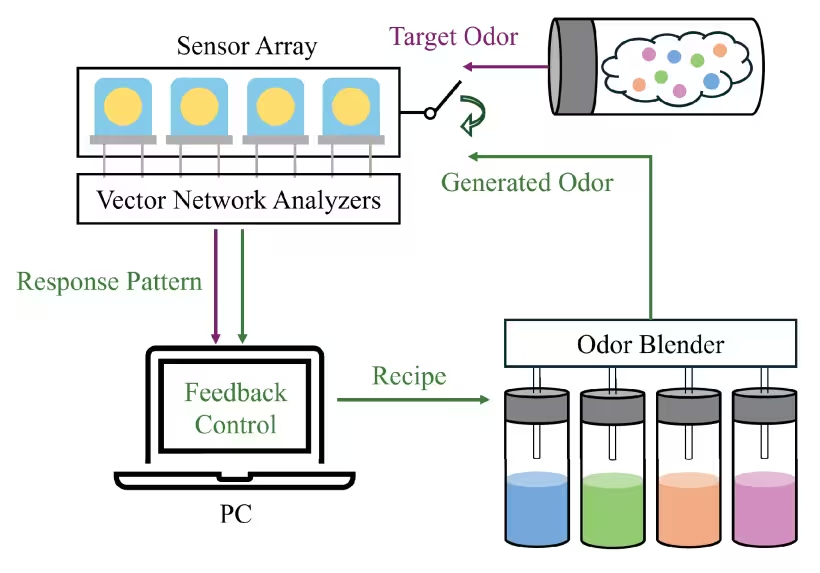
The conventional passive measurement method for quantifying a gas mixture depends on a pre-calibrated inverse model. However, even a minor change in sensor aging or environmental interference can affect this model. In contrast, this system uses active sensing, which involves comparing the target odor's response patterns with those of the generated mixture. It continuously adjusts the composition of the generated mixture until the difference between the composition and the target approaches zero. This method focuses on relative differences rather than absolute sensor responses, thereby enhancing its robustness against internal and external interference.
This work uses four QCM sensors. Typically, the focus has been on measuring the fundamental resonance frequency shift of each QCM. However, by using Vector Network Analyzers (VNWAs), both frequency shifts and resistance changes of multiple odd harmonics (up to the 11th order) were measured. Although VNWAs were initially expensive and bulky, advancements have reduced their size and cost, enabling them to be used with each QCM.
This technique can capture the viscoelastic properties of the sensor coating in addition to mass loading. It effectively turns four physical sensors into a virtual sensor array. This expanded sensor array significantly enhanced the system's ability to quantify each ingredient without increasing hardware size and cost. By introducing harmonic responses to frequency shifts and resistance changes, the system achieved a 47.44% reduction in root mean square error (RMSE) for quantifying quaternary odor mixtures.
By applying active sensing and multi-harmonic QCM responses, this system quantified quaternary odor mixtures with just four QCM sensors, achieving high accuracy (average relative percentage error of 8.13%). The system's short and long-term repeatability was verified over 14 days and 1 year, respectively. The work simulated situations in which one response or one sensor fails, demonstrating the system's adaptability.
This research shows that the multi-harmonic frequency-resistance responses of QCMs can improve the selectivity of the array. This improvement expands the quantification range, increases accuracy, and enables better analysis of odor mixtures, highlighting a promising direction for electronic nose (e-nose) technology. Future work will explore the possibility of advanced odor mixtures with additional odor components and seek to enhance performance by experimenting with novel sensor coatings.