



A Novel Tactile Sensing Skin for Surface Perception
Every touch tells a story. Human touch represents one of the most intricate forms of perception. It allows differentiation between smooth and rough, hard and soft, warm and cool, often without conscious effort. Reproducing this combined sensitivity in machines presents a significant challenge but is a key step towards advanced industrial robotic systems and medical prosthetics. This research introduces a type of electronic skin that combines two sensing mechanisms to achieve artificial perception that approximates human touch.
In this approach, two complementary sensing elements are paired: one for pressure and the other for temperature. It captures the different facets of material properties. The tactile sensor is fabricated from a porous zinc oxide-silicone composite that produces distinct electrical signals under pressure. Microscopic air pockets within the material amplify its responses, thus enabling the detection of small forces. The sensor distinguishes surface texture solely from pressure patterns.
The second component adds thermal awareness. Different materials emit heat in unique ways, and capturing those radiative signatures enhances identification. A noncontact thermal sensor positioned millimeters above the surface measures these variations. Its composite structure enables the detection of a rapid temperature shift comparable to that of commercial sensors. Each sensor operates in its optimal regime, providing synchronized mechanical and thermal information. These, once combined, convey a more complete surface characterization than either could achieve alone. All this could be achieved within a compact, interference-free structure.
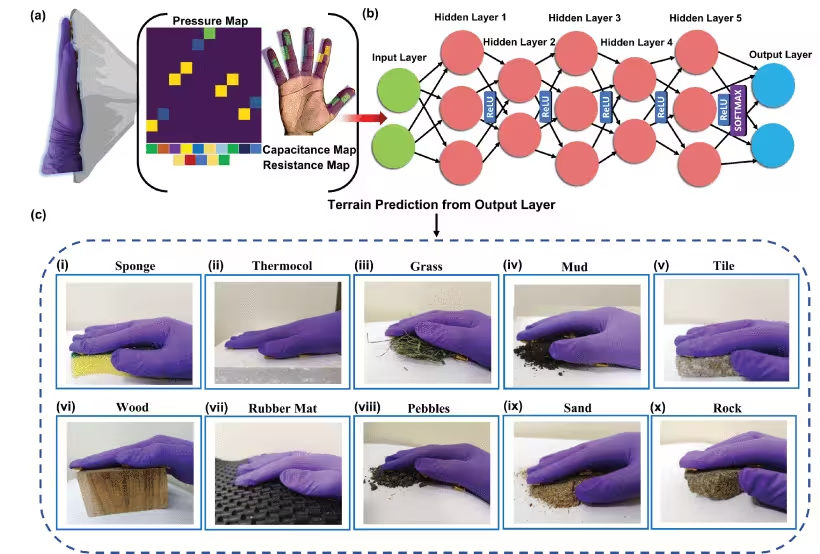
To interpret the data, the researchers collected over 10,000 readings across 11 distinct surface types (such as wood, sand, grass, etc.). A multilayer perceptron processes these measurements and learns the complex relationship between inputs and the output. The trained model achieved 87% accuracy in surface identification, outperforming other sensor systems. Even surfaces with minimal representation, such as a balloon surface with only 22 samples among 10,000 total measurements, were correctly classified, demonstrating algorithmic robustness.
Along with accuracy, the system also prioritizes practicality. Measuring only 10 × 10 × 2 mm and consuming power in the nanowatt range, it operates for extended periods on minimal energy. A prototype integrated into a glove endured real-world testing on uneven terrain and varied materials, thus confirming its performance outside controlled laboratory conditions. Fabrication of the prototype doesn't require any specialized equipment beyond standard laboratory tools, which suggests scalable manufacturing potential.
Applications of the novel tactile sensing skin span multiple domains. Industrial robots can adjust grip force based on the fragility of the object. Autonomous vehicles can identify road conditions and modify traction control accordingly. Prosthetic limbs can restore sensory feedback, allowing users to gauge temperature before grasping hot objects or sense texture when holding items. Each application requires machines that perceive their environment rather than merely measure it.
This tactile sensing skin transforms discrete measurements into an integrated perception. The merging of tactile and thermal sensing with intelligent data processing narrows the gap between artificial and biological touch, advancing robotic hands, prosthetics, and smart systems that truly feel the world they interact with.