




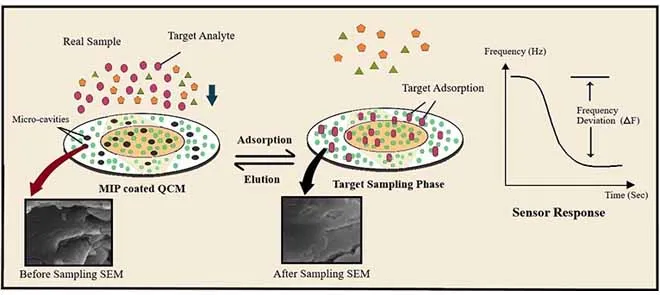
A Molecular Imprinted Quartz Crystal Microbalance Sensor for Reliable Detection of Alpha-Terpineol in Various Pine Essential Oils
Alpha-terpineol (A-Te) is a naturally occurring aromatic compound found in various essential oils. A-Te is widely used in aromatherapy, naturopathy, perfumery, cosmetics, and herbal medicine for its fragrance and therapeutic properties. Though non-toxic in small quantities, prolonged inhalation or overdosing may cause skin and eye irritation, making it vital to determine its concentration in essential oils. However, its precise quantification within a typical sample requires expensive instruments such as gas chromatographs (GC-MS).
This study presents a novel, low-cost, and robust chemical sensor designed for the reliable detection of A-Te in pine and various essential oils. Molecular Imprinted Polymer (MIP)-based Quartz Crystal Microbalance (QCM) sensor developed offers a simple, affordable, and sensitive solution for A-Te detection.
The sensor’s heterogeneous polymer layer selectively recognizes A-Te molecules. The polymer was synthesized using methyl methacrylate (MMA) and acrylic acid (AA) as the monomers via thermal polymerization, with tung oil added to enhance sensitivity and structural integrity. During fabrication, the sensor surface was imprinted with A-Te molecules, which were later removed by washing with a suitable reagent, creating molecular cavities within the polymer material that are similar in shape to A-Te.
When exposed to a gas containing the target molecules (A-Te), the sensors fit precisely into these cavities, resulting in a measurable frequency shift in the quartz crystal. The 10 MHz quartz crystal serves as a highly sensitive transducer capable of detecting nanoscale mass changes. The noise-free, high-fidelity oscillator precisely captures these subtle frequency variations.
The sensor showed excellent performance, achieving a sensitivity of 0.149 Hz ppm⁻¹ of A-Te, a broad detection range (5–800 ppm), and a limit of detection (LOD) of 1.33 ppm. It demonstrated commendable repeatability and reproducibility of 92.3% and 90.7%, confirming its consistency across repeated trials. Performance remained stable across varying humidity levels, and the sensor retained accuracy for up to 80 days, indicating strong durability.
Comprehensive chemical and structural characterization of the developed sensing material has been performed using Fourier Transform Infrared Spectroscopy (FTIR) and Scanning Electron Microscopy (SEM), which validated successful molecular imprinting and the formation of micro-scale porous structures. The MIP-QCM sensor exhibited high selectivity toward A-Te compared with other similar compounds, such as linalool, limonene, eugenol, and terpinolene, commonly found in pine oils.
The sensor's performance was compared with GC-MS analyses of four commercial pine essential oils. Using Principal Component Regression (PCR) and Random Forest Regression (RFR) models, the sensor data showed strong correlation with GC-MS results. Notably, the PCR model achieved a prediction accuracy of 96.38%, demonstrating the sensor’s reliability as a practical alternative for rapid, field-level quantification of A-Te.
The developed system combines high sensitivity, selectivity, reproducibility, and long-term stability with a cost-effective and scalable fabrication process. This work is the first successful detection of alpha-terpineol using a molecularly imprinted QCM sensor. It offers a powerful, accessible approach for on-site detection of volatile organic compounds, particularly in natural product analysis, food quality testing, and medical diagnostics, bridging the gap between laboratory precision and real-world practicality.