



A Low-Cost Multispectral Device for In-Field Fruit Ripening Assessment
Accurately determining fruit ripeness is a key challenge in precision agriculture, as it directly affects harvest timing, product quality, overall yield efficiency, and storage and marketing. Traditional methods, including chemical analyses and laboratory-grade spectroscopy, provide reliable measurements but are costly, time-consuming, and impractical for field deployment. Farmers still rely largely on experience and visual inspection, which is subjective and influenced by ambient lighting.
This research introduces a low-cost multispectral device for in-field assessment of fruit ripening, which is designed as a compact, affordable, and portable system. The device enables non-destructive evaluation of fruit maturity directly on-site, reducing both economic losses and food waste caused by improper harvesting.
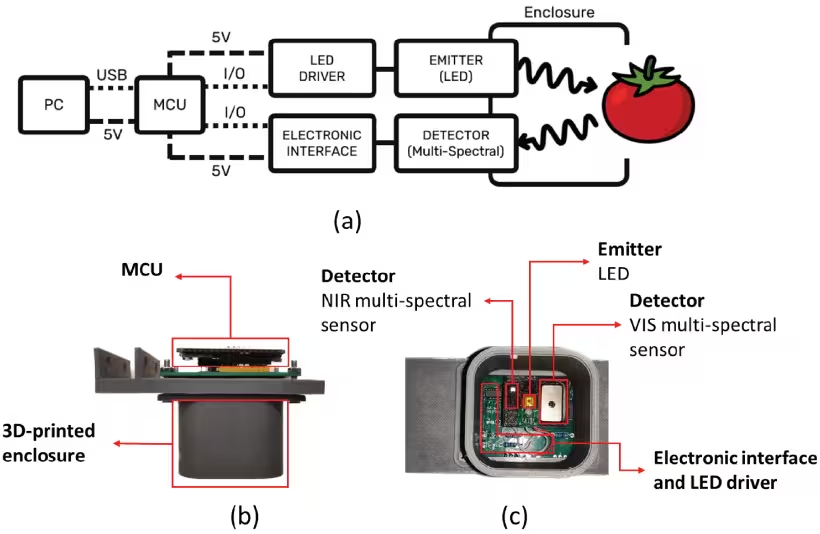
The proposed system integrates a broadband light-emitting diode (LED) with two visible–near-infrared (VIS–NIR) multispectral sensors spanning 52 wavelengths from 340 to 1050 nm. These components are housed inside a 3D-printed dark chamber that ensures a controlled measurement environment by shielding the sensors from external illumination. The compact configuration allows for both handheld operation and integration into robotic end-effectors for automated fruit inspection and selective harvesting.
Unlike most of the current low-cost multispectral devices, which rely on manually designed spectral indices tailored to specific fruit types, this system leverages machine learning to perform automatic feature extraction and classification. The ReliefF algorithm identifies the most relevant spectral features correlated with ripeness, while a Support Vector Machine (SVM) classifier categorizes fruits into discrete maturity stages. This automated process enhances the device’s versatility, enabling it to adapt to multiple fruit species without requiring redesign of the analysis pipeline.
Experimental validation was performed on tomatoes, a widely consumed crop with six defined ripeness stages: green mature, breaker, turning, pink, light red, and red-ripe. A dataset of 450 VIS–NIR spectra and 450 RGB images was collected. The study compared three methods: the proposed 52-wavelength multispectral configuration (MS-52), a lower-resolution 18-wavelength version (MS-18), and a standard RGB (red,green, blue) imaging setup. Results demonstrated that the proposed MS-52 device achieved an average classification accuracy of 93.72%, outperforming both MS-18 (88.52%) and RGB-based methods (86.92%).
Precision, recall, and F1-score metrics confirmed the superior reliability of the MS-52 system, highlighting its robustness to environmental variations and its ability to accurately determine multiple ripeness classes. Beyond performance, the device maintains cost-effectiveness, with a total material cost below €600, making it accessible to small-scale farmers and research institutions alike. Its low power consumption and compact design further support field usability.
The study demonstrates a novel integration of low-cost optoelectronics and machine learning for agricultural sensing. By combining spectral sensing, feature selection, and real-time classification, the system aims to bridge the gap between laboratory spectroscopy and field-ready smart sensors, ultimately enabling an accessible, smart, and sustainable fruit monitoring system. Future developments will focus on extending the dataset to other fruit species, embedding the device into robotic harvesting platforms, and implementing an intuitive interface for operation via user-friendly mobile devices or tablets.