



A Lightweight Perception Enhancement Network for Real-Time and Accurate Internal Surface Defect Detection of Cold-Drawn Steel Pipes
Cold-drawn steel pipes are essential components of pipeline systems used in aero-engines and high-pressure steam applications. They exhibit important mechanical properties and corrosion resistance. Surface defect detection is necessary to ensure operational safety. However, identifying internal surface defects is particularly challenging due to the enclosed internal environment. As the production demands increase, there is an urgent need for an efficient detection method that balances both accuracy and real-time performance.
Existing defect detection methods achieve high accuracy. However, they often incur substantial computational costs to develop comprehensive feature representations, thereby decreasing detection efficiency. Moreover, internal surface defects in steel pipes typically exhibit lower contrast and reflection, and sometimes involve confined spaces and minute defects. These challenges can degrade performance during model processing.
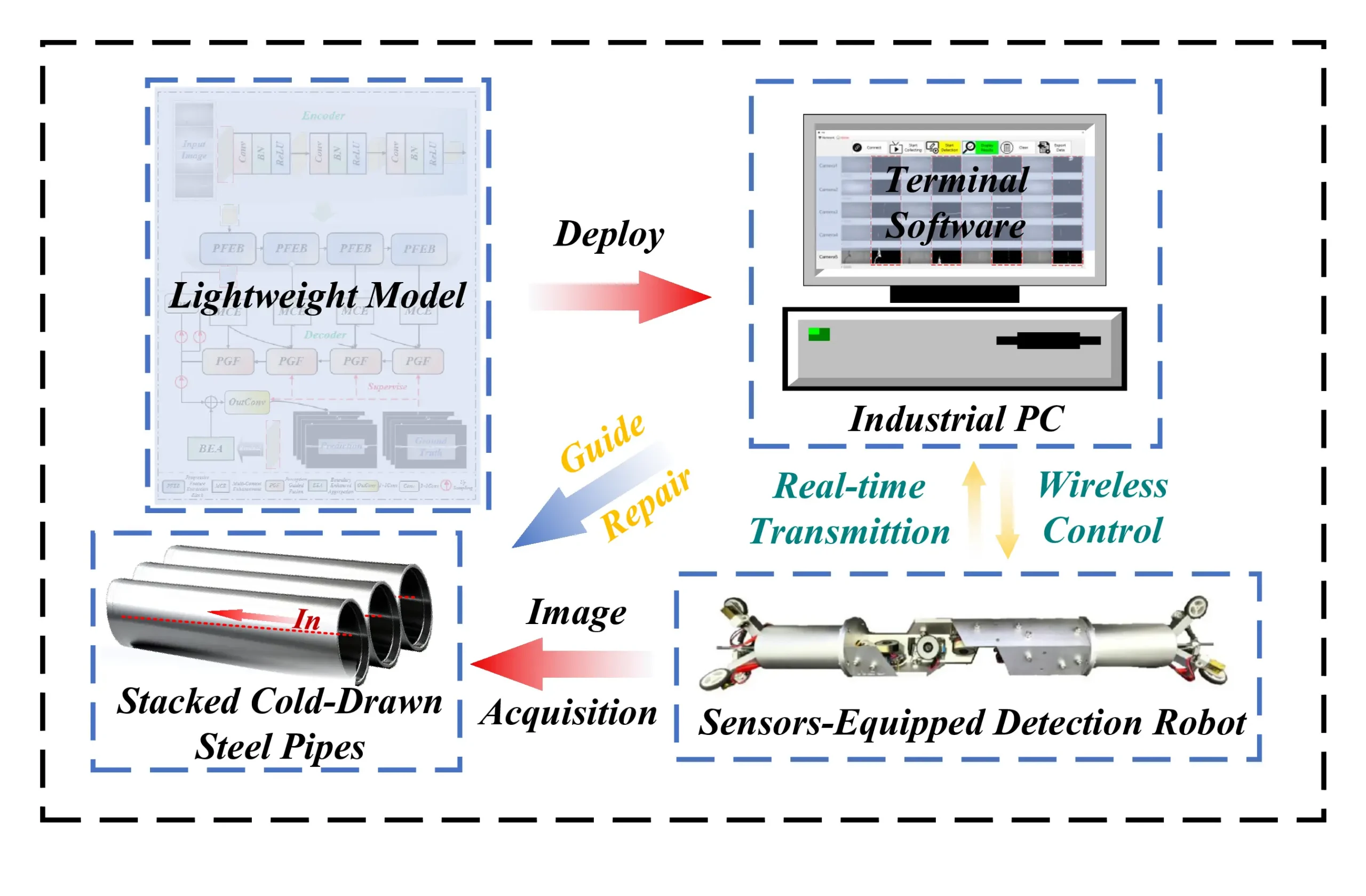
The study introduces a system that leverages wireless control and real-time transmission capabilities through terminal detection software. This approach incorporates a pipe internal surface detection (PISD) robot integrated with a lightweight perception enhancement network (LPENet) specifically designed for real-time detection of internal surface defects in cold-drawn steel pipes. The system demonstrated a significant improvement in detection efficiency when compared to several leading industrial detection methods.
During image acquisition, operators issue commands through the software to wirelessly control the Pipe Internal Surface Detection (PISD) robot. This enables the robot to navigate adaptively within the pipe and capture images of the entire internal surface. The collected images are then compressed and wirelessly transmitted to the host, where a neural network ensures accurate and efficient defect detection.
For terminal detection, a Lightweight Perception Enhancement Network (LPENet) is employed on the host to ensure accurate and efficient defect detection. LPENet adopts a two-stage lightweight encoder that integrates the Multi-Context Enhancement (MCE), Perception-Guided Fusion (PGF), and Boundary-Enhanced Aggregation (BEA) modules. Each intermediate layer’s output features are supervised, and the final saliency prediction map is generated. The parameters of all the modules are mutually independent, with no weight sharing.
In actual tests, the system is evaluated in an industrial setting. Specifically, the PISD robot can navigate through an 8m long cold-drawn steel pipe at a speed of 0.4 m/s. During this navigation, the robot's five vision sensors capture images at a rate of 10 frames/second, allowing it to collect approximately 1000 images over the 20 seconds it takes to traverse the pipe. Although image transmission time is ignored, the estimated actual detection speed is 1 m/s, and the total detection time is 28s, while maintaining a lightweight deployment size of 6.1 MB. This outstanding performance can be attributed to the effective training strategy and the task-specific network design.
This research introduces an innovative system for real-time, accurate, and faster wireless inspection and detection of internal surface defects in cold-drawn steel pipes. LPENet, integrated with the PISD robot and terminal detection software, maintains a lightweight model suitable for deployment while effectively addressing common challenges in detecting defects in cold-drawn steel pipes. The method helps reduce production errors, ensure structural integrity, and improve overall efficiency and safety in steel production.