



A High-Sensitivity Microwave Sensor Based on Unequal-Width Three-Coupled Lines for Characterizing the Permittivity of Liquids
In recent years, various microwave sensors have been extensively studied and applied for the dielectric characterization of liquid materials. Among these, coupled-line structures have notably shown significant potential in sensing applications due to their compact design and low complexity. However, liquid materials usually have a higher permittivity than solids, imposing greater demands on the detection range and sensitivity of the sensors.
In response to the aforementioned challenges, this study proposes a planar microstrip sensor based on unequal-width three-coupled lines (UWTCLs) for the dielectric characterization of liquids. The sensor features a configuration of three parallel coupled lines to enhance interline coupling effects, while incorporating an unequal-width design to optimize the electric field distribution. Specifically, the wider center line accommodates a greater number of induced charges due to its larger surface area, while the narrower side lines effectively concentrate these charges at their tip regions. The synergistic interaction between the wide and narrow lines significantly enhances the fringe field effect and electric field concentration, thereby improving the sensor's sensitivity and resolution.
The researchers developed equivalent circuit and capacitance models for the proposed UWTCLs structure based on odd- and even-mode analysis methods. Additionally, the influence of coupled-line widths on frequency shift was systematically investigated, and design strategies to optimize sensor sensitivity were further explored.
The analysis revealed that increasing the width of the center line while reducing the width of the side lines maximizes the frequency shifts. Additionally, a cubic polynomial fitting model was developed to relate the dielectric constant to the resonant frequency using extensive simulation data. This model achieved a high correlation coefficient of 0.9992, enabling accurate extraction of permittivity from measured resonant frequencies.
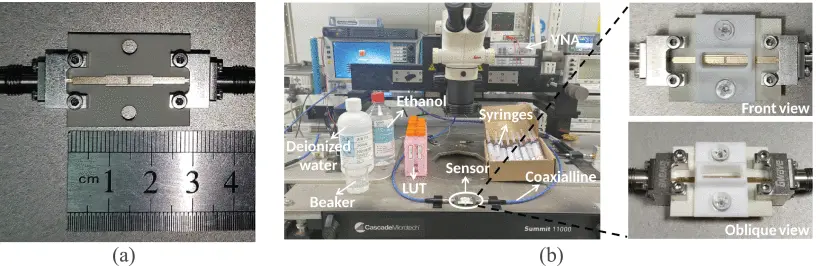
A sensor prototype was fabricated to evaluate the feasibility of the proposed design. The substrate used was Rogers 4350B, measuring 29 mm × 22 mm × 0.508 mm. The metal layer featured a gold-plated copper structure to enhance environmental durability and improve high-frequency performance. In the experiments, a polytetrafluoroethylene container with an internal volume of 240 μL was used to hold the liquid samples, which helped minimize measurement errors due to its low permittivity of approximately 2.05.
The experimental results demonstrate that the proposed sensor significantly outperformed others in detecting a broad range of permittivity values, from 1 to 75.443. It achieves a maximum normalized sensitivity of 4.891%, an average normalized sensitivity of 2.064%, and a minimum frequency resolution of 75.183 MHz. The measured resonant frequencies showed excellent agreement with the reference values, displaying an average relative error of 5.611%. Overall, the proposed sensor exhibits superior sensitivity and resolution across a diverse range of dielectric constants, surpassing the performance of previously reported sensors.
This study introduces a highly sensitive, compact, and easy-to-fabricate microwave dielectric characterization method for determining the permittivity of liquid materials. The proposed novel sensor shows superior performance across a wide range of permittivity values, making it suitable for applications in industrial manufacturing, biomedicine, quality control, and related fields.