



3D-Printed Airflow Hair Sensor Inspired by the Buthus occitanus Scorpion’s Flat Trichobothria
Insects and arachnids have highly sensitive hair-like mechanoreceptors, often referred to as trichobothria or trichoid sensilla, that can sense airflow, low-frequency near-field sound, acceleration, and touch efficiently. In this work, inspired by the flat trichobothria of the adult Buthus occitanus scorpion, the researchers have developed a 3D-printed airflow sensor that combines bio-inspired geometry with scalable fabrication. Using Digital Light Processing (DLP), multiple sensors can be produced simultaneously with micrometre precision, enabling rapid fabrication of sensor arrays or geometrically tuned variants within a single print.
This approach allows for customization of sensitivity and operating range by adjusting the height or thickness of the hair-like structures. This makes low-cost airflow sensing accessible across a range of applications, from robotics to environmental monitoring. A comprehensive time-and-cost analysis is necessary; however, printing 44 sensors takes approximately 40 minutes, and the estimated material cost for the 3D-printed sensors ranges from $0.18 to $0.36. There is potential to reduce costs further.
The developed sensor features a flattened surface similar to the trichobothria of the adult scorpion Buthus occitanus. The flat surface enhances the mechanical response of the artificial hair-like sensor to winds. Additionally, the sensor uses two different materials to improve transduction, which is inspired by the two-material composition found in arachnids and insects.
The hair shaft of the sensor is designed to be rigid to prevent bending, while the basal area is softer. This design enables the sensor to deflect most of the stress to the basal area, which experiences the elevated stress, and is responsible for transduction. The sensor's basal area was printed in a standard piezoresistive serpentine pattern and coated with platinum. When the sensor bends, the platinum layer either stretches or contracts, changing its electrical resistance. This change in resistance can be detected by appropriate circuitry that measures changes in voltage and is used to estimate airflow velocity.
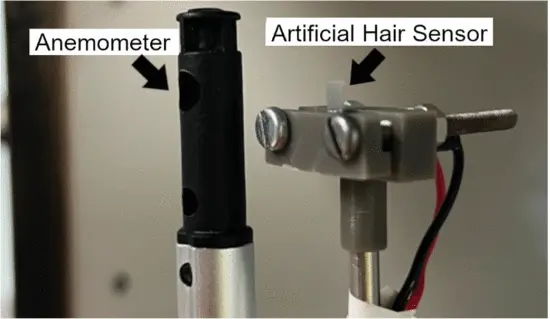
A wind tunnel and a commercial anemometer were used to evaluate the sensor's response. The result demonstrated a sensing range between 6.8 m/s and 22.3 m/s and an average measurement error of less than 1% under the tested conditions. Since the wind tunnel's upper limit was 22.3 m/s, further study is required to assess the upper range of the sensor, as the sensor's response suggests the potential to detect higher wind speeds.
Additional experiments conducted at various angles and at a fixed airflow velocity showed that the sensor also exhibits directionality. The sensor's response can be adjusted by modifying the thickness, height, and/or basal area of the hair shaft. For example, thicker sensors show a wider sensitivity range, while thinner sensors can detect lighter winds. These geometric changes can be easily introduced during the DLP printing process. Further work may focus on reducing costs and production time, improving sensor response, and enabling the sensor to operate effectively underwater.