



Robotic Systems for Sewer Inspection and Monitoring Tasks: Overview and Novel Concepts
Sewer systems are a critical infrastructure that safeguard public health and protect the environment. The sewer network in urban planning is extensive and consists of pipes of various materials and designs. To ensure their functionality, sewer systems must be inspected regularly and systematically.
Common defects in sewer systems include cracks, deformations, damaged house connections, and misaligned joints. For each defect, it is important to document the type, severity, and location. Robotics platforms are used for inspections because most pipes are too small for direct human access. In current practice, a trained operator remotely drives a tethered robot through the pipe, inspects the live video feed for defects, and manually records all observations.
Commercial inspection robots can be classified by inspection range, drive concept, sensor types, and localization method. Most systems cover pipe diameters from about 200 mm to 3,000 mm, with specialized vehicles for very small and very large pipes. All robots are tethered, with cable lengths ranging from 100 m to 300 m. Drive concepts include wheeled, tracked, articulated, and flying or swimming platforms. Wheeled and tracked robots are versatile and fast. Articulated, flying, or swimming systems can navigate obstacles more easily, but complicate distance estimation because wheel encoders are not available.
Cameras are the sensors used for it. Axial cameras, often used as rear-view cameras, point along the pipe axis. The primary tool for detecting and documenting defects is the manually operated pan-tilt-zoom cameras. However, they cover only a limited field of view at any given time, so defects outside this area may remain undocumented, thereby restricting automatic analysis. Fisheye cameras capture the full pipe circumference for subsequent analysis on an unwrapped texture, yet the areas near the image borders, where most relevant information lies, are strongly distorted.
Some systems use basic laser profilers that generate sparse cross-sectional point clouds, facilitating simple diameter estimation but lacking detailed deformation analysis. High-density 3D laser scanners and specialized sensors like sonar or radar are rare in commercial products. Localization typically relies on a tether encoder, sometimes combined with an inertial measurement unit.
The shortage of skilled operators, combined with extensive sewer networks, creates significant demand for more automated and autonomous inspection solutions. Additionally, camera-based systems, though useful, have limitations for geometric measurements and can be challenging to use for large-scale off-site evaluation.
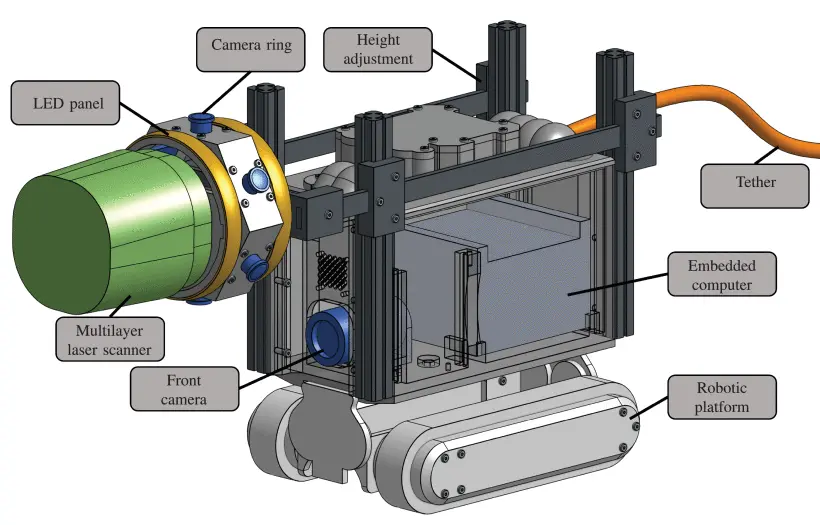
To address these limitations, the researchers propose a novel prototypic inspection robot. The system uses a precise 3D laser scanner to acquire a dense point cloud of the inner pipe surface and a ring of high-resolution cameras oriented towards the pipe wall to record texture information. A tracked platform drives the robot, and its pose is estimated using track encoders and an inertial measurement unit. A high-performance embedded computer enables onboard data processing and real-time or near-real-time defect detection and quantitative geometric analysis during inspection.
The proposed concept enables automated, repeatable inspections, supports reliable AI-based defect detection, and provides accurate quantification of geometric defects, thus significantly improving the quality, efficiency, and completeness of sewer condition assessment.