



An EMAT Based on a Novel Extrusion Static Magnetizer for Thickness Measurement of Steel Plates
Electromagnetic acoustic transducers (EMATs) have unique advantages, including non-contact operation and couplant-free usage. They can generate various types of ultrasonic waves through different magnet-coil configurations and are widely used to measure the thickness of ferromagnetic plates. The primary working mechanism is the Lorentz force, which means the signal-to-noise ratio (SNR) of an EMAT is proportional to the square of the strength of the static magnetic field. Therefore, increasing the intensity of the static magnetic field can effectively improve EMAT performance and optimize detection SNR.
However, the existing symmetrical repulsive magnetizers adopt a quadrupole symmetric arrangement, leading to the symmetric divergence of the central magnetic field. This results in low efficiency in utilizing the upper components of the magnetic field, making it challenging for the magnetic field to act efficiently on the surface of the steel plate being tested.
This study proposes a novel extrusion static magnetizer designed to address and overcome the existing technical limitations. It features a central structure made of a magnet-silicon steel composite that concentrates the magnetic field toward the center. This is achieved via magnetic pole repulsion and compression effects, allowing previously unused upper magnetic field components to be directed onto the detection surface of the specimen.
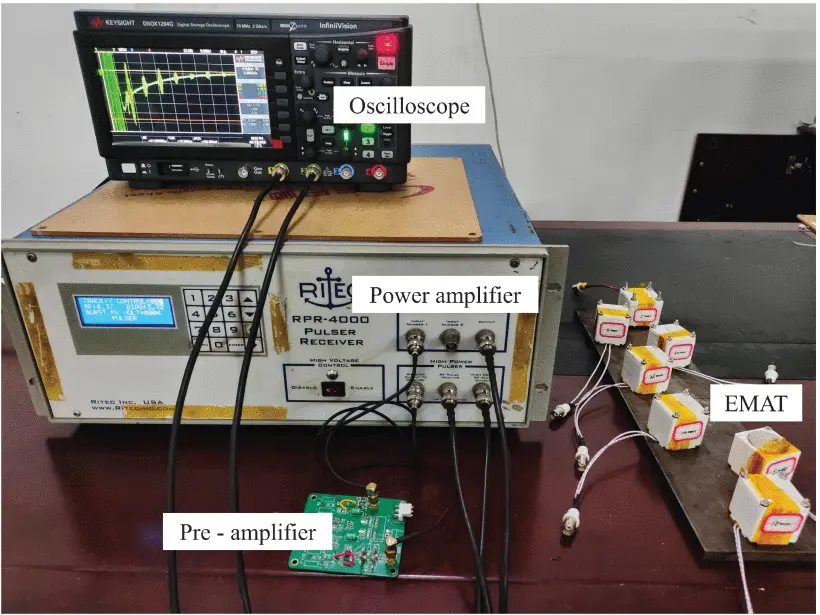
This paper systematically investigates the performance optimization mechanism of the proposed magnetizer structure. It does so by combining equivalent magnetic circuit model analysis, three-dimensional static magnetic field simulation, and experiments to measure the thickness of the steel plate. Theoretical calculations and simulation results indicate that the vertical magnetic field intensity exhibits a unimodal trend, first increasing and then decreasing as the central magnet ratio increases. The optimal magnetic field intensity is achieved at a 50% magnet proportion, resulting in a 9.6% improvement compared to the original structure.
The experimental results of measuring steel plate thickness are highly consistent with the theoretical analysis and simulation rules. The signal amplitude also shows a unimodal trend, first increasing and then decreasing as the magnet size increases. With the optimal parameter configuration, which includes 50% magnet proportion, the sensor signal amplitude reaches 263 mV. This represents a 159.7% increase compared to the original repulsive structure and a 460.4% increase compared to the single magnet structure. In terms of signal-to-noise ratio (SNR), the results are 8 dB higher than those of the original repulsive structure and 15 dB higher than those of the single magnet structure.
The performance of the proposed scheme is significantly superior to that of single magnet structures and repulsive structures. This results in enhanced utilization of the magnetic field and improved quality of the detection signal. The optimization concept and design method introduced in this study—directionally compressing the idle magnetic field of symmetrical repulsive magnetizers—can provide an important reference for further improving sensor performance in future research.