



Design and Simulation of an MEMS Capacitive Pressure Sensor With Multiple Annular Cavities
Pressure sensing is essential in many engineering systems, including aerospace equipment, industrial automation, automotive control, and medical devices. Among various pressure sensing technologies, MEMS capacitive pressure sensors (CPS) are popular for their high sensitivity, low power consumption, and compatibility with microfabrication processes. However, achieving both high sensitivity and good linearity simultaneously in conventional CPS can be challenging. Improving one performance metric often degrades the other, limiting their effectiveness in practical applications.
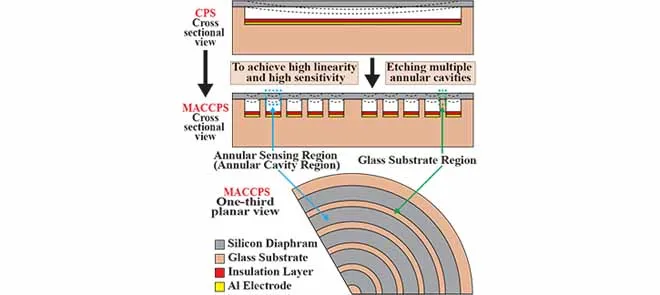
To address this issue, this research proposes a new MEMS capacitive pressure sensor design featuring multiple annular cavities within the sensing structure. Instead of using a single large cavity beneath the diaphragm, the proposed design divides the sensing area into several concentric annular regions by etching multiple circular cavities into a glass substrate. Each annular region has the same radial width, allowing them to exhibit very similar mechanical deformation behavior when external pressure is applied.
When pressure is applied to the sensor, the silicon diaphragm placed above each annular cavity deflects toward the fixed electrode on the substrate. This deflection alters the capacitance. Because the deformation behavior of the annular regions is highly consistent, the capacitance variation from each region follows a similar trend. The total capacitance output of the sensor is obtained by combining the contributions from all annular regions. This structural design improves the overall sensitivity while maintaining a relatively linear relationship between pressure and capacitance.
To analyze the proposed structure, a mathematical model based on classical plate theory was first established to describe the diaphragm deflection and capacitance variation. Finite element simulations were then performed using COMSOL Multiphysics to evaluate the mechanical deformation and electrical response of the sensor. Various structural parameters were investigated to determine an optimal design configuration.
Simulation results show that the optimized sensor achieves a sensitivity of approximately 0.0944 pF/kPa and a nonlinearity of 2.09% of full scale within a pressure range of 0–100 kPa. In addition to the primary measurement range, the sensor also demonstrates stable operation under higher pressures. Reliable performance is maintained up to 150 kPa, and the sensor can resume operation in a higher pressure region between 450 kPa and 1000 kPa after contact between the diaphragm and electrode. Furthermore, the simulated overload pressure reaches 3.1 MPa, approximately 31 times the full-scale pressure, indicating strong mechanical robustness.
The effects of temperature and residual stress on sensor performance were also investigated. The results show that the sensor maintains sensitivity above 0.05 pF/kPa and nonlinearity below 3% full scale over a temperature range from −50 °C to 100 °C, demonstrating good thermal stability.
The proposed design featuring multiple annular cavities significantly improves the sensitivity of MEMS capacitive pressure sensors while maintaining good linearity and mechanical reliability. This innovative approach offers a promising solution for high-performance pressure sensing applications in fields such as industrial monitoring, automotive systems, and aerospace instrumentation.