



Development of a Terahertz Metamaterial Micro-Biosensor for Ultrasensitive Multispectral Detection of Early Stage Cervical Cancer
Cervical cancer is one of the most common cancers among women and a leading cause of death, even though it is preventable and treatable. Early detection of cervical cancer increases the survival chances. However, invasive Pap smears and tissue biopsies to detect cancer have limitations. They may miss subtle precancerous changes, leading to delayed diagnosis.
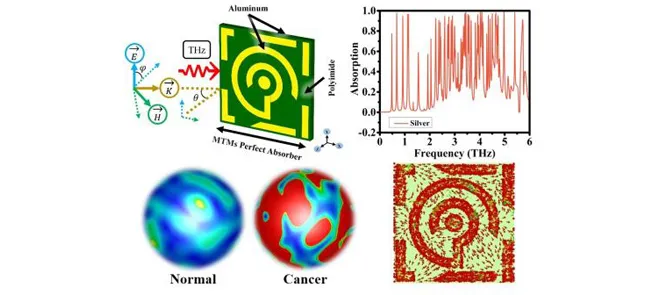
This research presents a multiband metamaterial (MTM) perfect absorber operating over 0-6 THz. Terahertz (THz) biosensors offer a promising label-free option by detecting unique biomolecular vibrational fingerprints in tissue samples. It uses patterned aluminum resonators on a polyimide substrate to create over 18 sharp resonance peaks for detailed spectral analysis.
To enhance performance, the design evolves in stages. It begins with a single square split-ring resonator with peaks at 2, 3, 3.5, 4, and 5.5 THz. Circular path hybrids then improve the 1 THz range. Bullseye variants focus on 3-5 THz. The final hybrid model achieves near-perfect absorption across the full range. Its 150-by-150-micrometer unit cell uses subwavelength patterning. This creates negative permittivity and refractive index in key areas, as shown by permittivity and permeability analyses.
Material choice was crucial. Polyimide substrates outperform PET, Rogers, or Arlon materials across various frequency bands. Aluminum resonators match gold's performance at a lower cost and work better with fabrication processes. Tuning substrate thickness reveals 40-60 micrometers as optimal. Thinner layers tend to broaden resonance peaks, while thicker layers sharpen them, which is essential for distinguishing between biomarkers.
The real component indicates energy storage, while the imaginary part represents dissipation. H-field patterns rotate in orthogonal directions to achieve strong magnetic coupling. Surface currents confirm LC resonance mechanisms that support multiband operation.
Microwave imaging with the HeLa cell model shows promising clinical applications. Healthy cervical tissue has a refractive index of 1.368, while cancerous tissue has a refractive index of 1.392, resulting in apparent frequency shifts across all 18 absorption peaks. Cancerous samples show substantially stronger E and H-field distributions in red-intensity areas. These result from higher dielectric constants from increased cell metabolism, membrane changes, and nuclear crowding.
The performance metrics have set new standards. Sensitivity reaches 236,640 THz per RIU, quality factor hits 45.056, and figure of merit achieves 3,525,838 per RIU. Ten peaks exceed 97 percent absorption, six surpass 98 percent, and two top 99.8 percent, all within the 6 THz bandwidth.
The multiband design outperforms single-band graphene sensors. It provides full-spectral fingerprinting, reduces false negatives, and enhances biomolecular interactions through effective field localization. The compact size, flexible polyimide, and low-cost aluminum facilitate lab-on-chip integration and disposable screening platforms. Non-ionizing THz radiation ensures patients' safety, and real-time monitoring supports point-of-care use.
This terahertz (THz) micro-biosensor transforms cervical cancer screening by enabling early detection, which can improve survival rates to over 92 percent. The use of multispectral metamaterial absorption has the potential to set a new standard for label-free optical biopsies. Future applications could extend to colon, breast, and blood cancers through biomarker-specific resonance mapping. Additionally, machine learning-based spectral analysis could automate the diagnostic process.