



An Intestine-Based Biocompatible Humidity Sensor for Environmental and Medical Measurements
The rapid increase in electronic waste, driven by the widespread use of electronic devices, including traditional sensors, poses a major challenge worldwide. To prevent a potential catastrophe from the accumulation of e-waste, it's crucial to develop sustainable, and environmentally responsible alternatives made from biodegradable, biocompatible, and natural materials. While substantial work is underway and research advances have been made in developing organic and natural-material sensors, achieving long-term operational stability remains a considerable challenge.
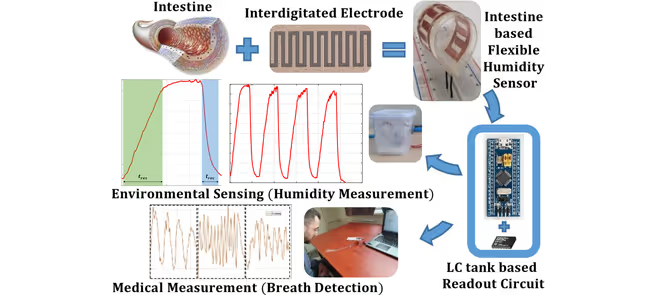
Motivated by the need to overcome the long-term stability challenge, the researchers in this study developed a humidity sensor using processed cattle intestine tissue as a sustainable, biocompatible sensing material that can maintain performance across diverse environmental conditions. The intestine is a naturally absorptive tissue, and processed cattle intestine casings are distinguished by their high permeability and sensitivity to moisture and smoke. Its inherent absorbency and resilience, along with historical use in food preservation, provide compelling evidence of its robustness and environmental stability.
The sensor structure comprises three main layers: (i) a humidity-responsive intestine-tissue sensing layer, (ii) an interdigitated copper electrode serving as the capacitive element, and (iii) a flexible plastic substrate that provides mechanical support.
The corresponding measurement system is based on a low-cost LC oscillator circuit that detects humidity variations by measuring frequency shifts caused by changes in capacitance. This compact and simple configuration offers high reliability and resistance to environmental fluctuations, making it suitable for practical deployment.
The sensor was characterized in a controlled test chamber across a relative humidity (RH) range of 20%-90%. Despite hysteresis being a common issue in biomaterial-based sensors, the sensor exhibited stable capacitance–humidity characteristics with low hysteresis. The response and recovery times were approximately 8.7 and 4.5 minutes, respectively. The values primarily reflect the stabilization of the experimental test setup rather than limitations of the sensor itself.
To evaluate its performance in real-world conditions, respiratory monitoring experiments were conducted. When positioned 15cm from the mouth, the sensor effectively distinguished between deep, regular, and rapid breathing patterns. This confirmed its responsiveness to short-term humidity fluctuations associated with human respiration, underscoring its suitability for physiological monitoring.
Long-term stability was also assessed under uncontrolled laboratory conditions. Remarkably, the sensor maintained consistent performance after 56 weeks of storage, equivalent to more than one year, with no measurable degradation observed across temperatures ranging from 0°C-50°C. This level of durability represents a notable advancement for sensors based on organic and biological materials.
Beyond environmental measurements, the developed sensor shows strong potential for healthcare applications. Its sensitivity and repeatability in detecting exhaled humidity indicate its promise for use in non-invasive respiratory monitoring systems, such as wearable medical devices and early-stage diagnostic tools for sleep apnea or other breathing disorders.
The study demonstrates a sustainable, biocompatible, and long-lasting humidity sensor based on processed cattle intestine tissue. The combination of material simplicity, cost-effectiveness, and stability positions this sensor as a strong candidate for integration into future medical and environmental monitoring technologies.