




Digital Twin-Assisted Fuzzy Logic-Inspired Intelligent Approach for Flood Prediction
Floods are among the most destructive natural disasters, resulting in large-scale human displacement, agricultural losses, and infrastructure collapse worldwide. As the frequency and severity of extreme weather events continue to rise, there is an urgent need for intelligent systems that can forecast flood occurrence with high precision and reliability. A smart framework addresses this challenge by combining digital twin (DT) simulation, IoT-driven sensing, adaptive neuro-fuzzy learning, and blockchain security to achieve accurate flood forecasting, along with data sharing for preparedness and disaster management.
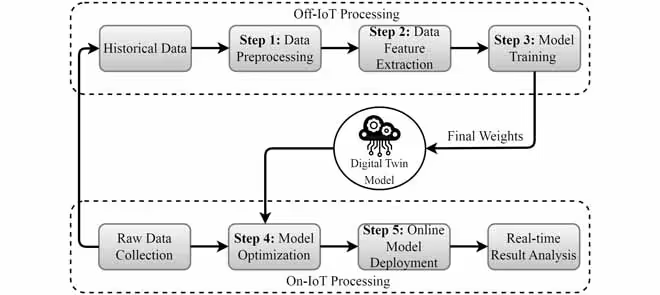
The system continuously monitors hydrological and meteorological parameters, including precipitation, water level, water flow, humidity, temperature, and seasonal attributes, collected via distributed IoT sensors. Since these variables come from diverse sources and are captured at different sampling rates, a data synthesis mechanism aligns them using a weighted interpolation approach. This transforms irregular time-series inputs into unified patterns suitable for modelling, while preserving critical parameter relationships.
Once the data is preprocessed, a digital twin model simulates the hydrological behaviour of the monitored region. This virtual representation captures how meteorological and hydrological factors interact, providing a dynamic environment for advanced predictive analytics. The next stage involves a neuro-fuzzy intelligence model, which blends neural networks’ ability to learn complex patterns with fuzzy logic’s capacity to reason about uncertainty. This hybrid model calculates a continuous flood vulnerability score, the Flood Index Value (FIV), which reflects the probability that existing conditions will lead to flooding.
Training is performed with a hybrid optimisation strategy over 50 epochs, using real environmental records combined with synthesised datasets to ensure broad coverage of possible scenarios. The model demonstrates strong predictive capability: training accuracy reaches 97.23% and testing accuracy reaches 95.58%. These performance levels significantly exceed those of conventional fuzzy logic systems and artificial neural networks evaluated under identical conditions. Error metrics further confirm the model’s robustness, with an R² value of 0.90 and low root mean square error and median absolute error values, indicating close agreement between actual and predicted flood conditions.
To support data exchange among agencies, authorities, and community systems, the framework incorporates a secure blockchain layer. This decentralised ledger records flood-related events, predictions, and alerts in real time, ensuring that information cannot be altered or compromised. This ledger stores processed information using a reputation-based Byzantine fault-tolerant consensus mechanism.
The approach ensures low-latency verification and high throughput while resisting manipulation or unauthorised modification of disaster-related information. Latency grows modestly as network size increases, but remains within a practical range for real-time emergency operations.
Computational and transactional cost analyses further show that the system maintains efficiency despite its multi-layered architecture. This design supports timely warnings and coordinated decision-making, both critical during rapidly evolving flood scenarios.
The integrated architecture reduces computational burden compared to traditional hydrological simulations with a more agile, data-driven alternative while maintaining high predictive accuracy and reliability. By integrating real-time sensing, virtual simulation, intelligent inference, and secure communication, the system provides a versatile platform that supports early warning, risk mitigation, and climate-resilient planning across diverse geographic environments.