




Demonstration of Bare Laser-Reduced Graphene Oxide Sensors for Ammonia and Ethanol
Environmental pollution caused by toxic and volatile organic compounds (VOCs) poses a serious threat to human health. Ammonia (NH₃), while essential in biological and industrial processes, can cause respiratory damage and chemical burns at high levels. Ethanol (C₂H₅OH), widely used as a solvent and fuel additive, leads to central nervous system disorders upon overexposure.
This work presents the development and characterization of gas sensors based on laser-reduced graphene oxide (LrGO) as the active sensing layer for detecting ammonia and ethanol. The research addresses the growing need for cost-effective, low-energy, and highly sensitive sensors for environmental and industrial monitoring of volatile organic compounds (VOCs), which pose significant health risks at elevated concentrations.
Unlike conventional detection techniques such as photoionization and flame ionization, which are expensive and complex, the proposed approach leverages the unique properties of graphene derivatives to achieve simplicity, scalability, and sustainability.
The novelty of this study lies in the use of bare LrGO obtained through a laser-assisted photothermal process, without additional chemical treatments or composite formation. This method simplifies fabrication, reduces costs, and enables room-temperature operation, which is a major advantage over existing sensors that often require high-temperature conditions or complex material synthesis.
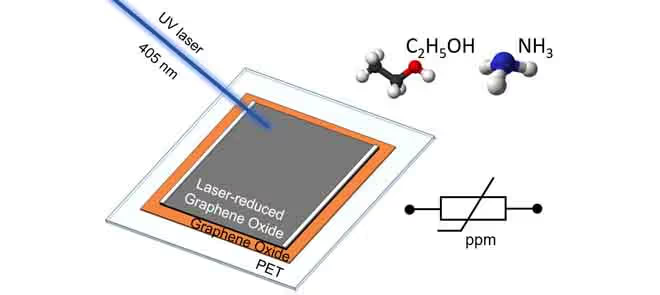
The LrGO films were prepared by depositing graphene oxide (GO) on polyethylene terephthalate (PET) substrates and subsequently reducing it using a CNC-controlled 405 nm laser at varying power levels (50 mW, 80 mW, and 100 mW). Structural and chemical transformations were confirmed through SEM, Raman spectroscopy, and XPS analyses, revealing improved crystallinity, reduced oxygen functional groups, and enhanced conductivity as laser power increased.Electrical characterization demonstrated that the sensors exhibit a purely resistive behavior up to 100 kHz, facilitating simple integration into electronic systems. Gas-sensing tests were conducted in a controlled chamber with concentrations ranging from 10–100 ppm for ammonia and 25–130 ppm for ethanol.
The sensors showed a clear increase in resistance with rising gas concentration, attributed to the p-type semiconducting nature of LrGO and its interaction with electron-acceptor gas molecules. Sensitivity values reached 0.0402%/ppm for ammonia and 0.0140%/ppm for ethanol at the highest reduction level, with excellent linearity (R² > 0.94) and minimal hysteresis (<0.005%). Interestingly, lower reduction levels (50 mW) yielded higher sensitivity due to increased surface corrugations and defect sites, enhancing gas adsorption.
Compared to other reduced graphene oxide (rGO)-based sensors reported in the literature, the proposed devices offer a superior balance between simplicity, performance, and sustainability. They operate at ambient temperature, require no chemical reduction or composite formation, and maintain reproducibility across multiple cycles. These features make LrGO a promising candidate for next-generation gas sensors aimed at environmental monitoring and industrial safety. Furthermore, the approach aligns with circular economy principles by minimizing energy consumption and material complexity.
This research demonstrates that laser-reduced graphene oxide can serve as an efficient, low-cost, and scalable solution for VOC detection. Future work may explore hybridization with other nanomaterials to further enhance sensitivity and selectivity, but even in its raw form, LrGO establishes a strong foundation for sustainable sensor technology.