



Ethylenediamine-Coupled Lysine-Modified Pencil Graphite Electrode for the Quantification of Indigo Carmine
The rampant use of synthetic food dyes has led to increased environmental and health concerns. Indigo carmine (IC), a common food colorant, is of particular concern due to its environmental persistence and potential toxicity. Consequently, there is an urgent need to develop sensitive, cost-effective, and reliable methods for detecting and monitoring IC in food products.
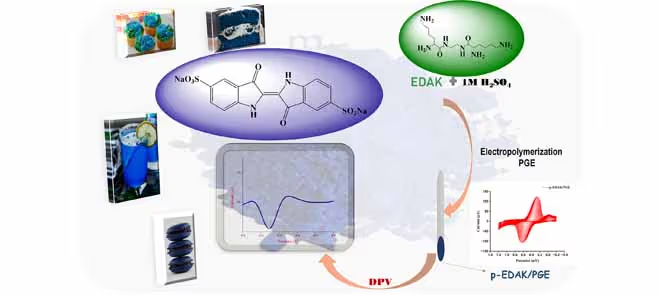
This study presents the development of a new electrochemical sensor for detecting IC, designed using a modified pencil graphite electrode (PGE). PGEs are suitable for practical sensing applications due to their low cost, disposability, biocompatibility, and widespread availability. To enhance the performance of the electrode, the researchers synthesized a compound called ethylenediamine-coupled lysine (EDAK) and used it as a functional material to modify the electrode surface. The EDAK compound was carefully characterized using techniques such as Fourier transform infrared spectroscopy (FT-IR), high-resolution mass spectroscopy (HRMS), and nuclear magnetic resonance (NMR) to confirm its structure.
The modified electrode was fabricated through electropolymerization, enabling EDAK to form a thin, functional coating on the PGE surface. A systematic optimization of the electropolymerization process was carried out by evaluating key parameters, including monomer concentration, polymerization cycles, solution pH, and potential scan rate.
The electropolymerization of lysine-based monomers on PGE was systematically characterized using multiple analytical techniques to confirm successful surface modification and evaluate changes in morphology and electrochemical performance. Comprehensive analyses using FT-IR, scanning electron microscopy (SEM), Atomic force microscopy (AFM), Raman spectroscopy, and electrochemical techniques confirmed that lysine electropolymerization on PGE substantially alters the electrode surface, enhancing its roughness, surface area, and conductivity.
The FT-IR analysis verified the successful incorporation of functional groups from the synthesised compound, while SEM images revealed distinct morphological changes compared to bare PGE. AFM and Raman spectroscopic techniques provided further evidence of polymer formation. Electrochemical impedance spectroscopy (EIS) showed a decrease in charge transfer resistance, indicating successful polymerisation and surface modification. These characterizations together proved that the electrode surface was effectively modified.
The detection of IC was assessed by differential pulse voltammetry (DPV). The analytical performance was exceptional, as evidenced by a linear detection range of 0.4 μM-110 μM and a low detection limit of 0.37 μM. The sensor’s exceptional capacity to detect low concentrations was indicated by a sensitivity of 73.61 μA/μM/cm2.
The sensor showed excellent reproducibility, repeatability, and reliable stability over several weeks. It exhibited excellent selectivity for IC. Structurally similar dyes such as sunset yellow, tartrazine, and erythrosine caused negligible interference, demonstrating their targeted specificity. The practical applicability was confirmed by testing commercial chocolate-coated candies, where recovery rates of 98–100% demonstrated its effectiveness in real-world food analysis.
In a nutshell, EDAK modified PGE offers a cost-effective, selective, and highly sensitive platform for monitoring IC in food samples. This approach is promising for practical applications in food safety and quality control due to its disposable nature, best analytical performance, and ease of electrode fabrication.