



An Open-Path Optical Sensor for Hydrogen Sulfide and Methane Detection by QCL
Hydrogen sulfide (H₂S) and methane (CH₄) are hazardous gases commonly released during high-sulfur oilfield operations and petroleum refining. When H₂S concentrations exceed 100 ppm, it can cause severe neurological effects and even be fatal. CH₄ levels above 5% create explosive risks. Conventional electrochemical detectors face several limitations, including zero-point drift, interference from water vapor, short lifespans, and frequent false alarms.
To overcome these challenges, the researchers proposed an open-path optical sensor based on a Quantum Cascade Laser (QCL) operating at 8.309 µm, combined with wavelength modulation spectroscopy (WMS). The selected mid-infrared (MIR) band ensures stronger gas absorption and minimizes water vapor interference, enabling high-sensitivity detection of H₂S and CH₄ over long distances.
H₂S and CH₄ exhibit distinct absorption lines at 8.3094 µm and 8.3054 µm, with negligible cross-interference. When the laser beam passes through a gas sample, the Beer–Lambert law relates the measured absorption to gas concentration and path length.
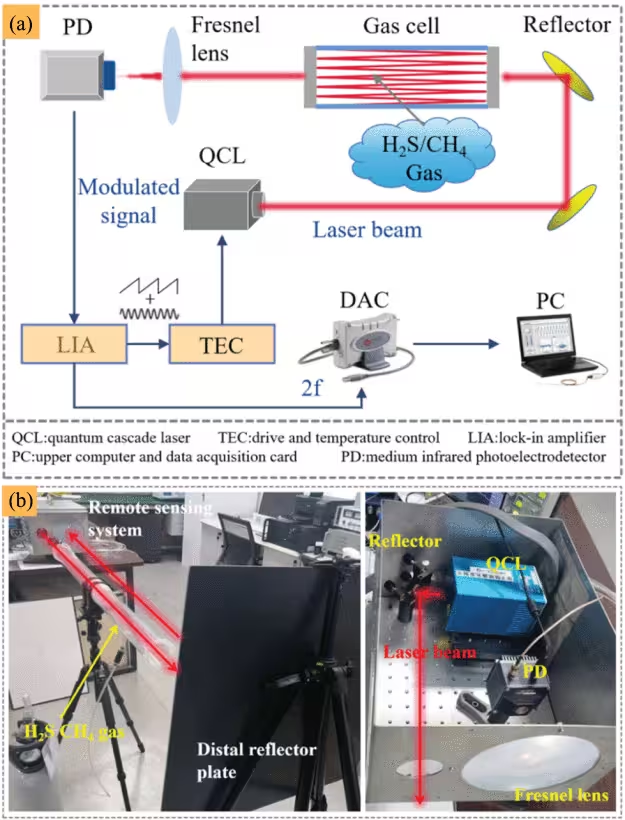
WMS enhances weak absorption signals by sinusoidally modulating the laser and detecting the second harmonic (2f) using a lock-in amplifier. In this setup, a temperature-stabilized QCL was driven by a saw-tooth waveform with a superimposed 60 kHz sinusoidal modulation. The laser propagated through open space, reflected off a distal mirror up to 50 m away, and was then collected by a Fresnel lens onto a mid-infrared detector.
Properly tuning the modulation depth optimizes the signal-to-noise ratio for more precise gas detection. Data were acquired at 5 kHz and processed for concentration retrieval, with experimental optimization identifying a modulation amplitude of 0.3 V as ideal for maximizing the 2f signal.
Calibration tests demonstrated linear responses of the 2f amplitude to varying H₂S and CH₄ concentrations. Signal filtering reduced noise caused by mirror scattering and environmental fluctuations. Allan variance analysis further showed that longer integration times effectively suppressed white noise, achieving detection limits of 0.593 ppb for H₂S at 183 s and 1.160 ppb for CH₄ at 142 s.
Field experiments at sensing distances of 15, 30, and 50 m revealed that longer distances weakened the signal due to beam spreading and environmental noise. Water droplets and dust on the reflector further degraded the signal quality, reducing the second harmonic by nearly 50%. Mechanical wipers were recommended to maintain reflector cleanliness for outdoor applications.
For a 100 ppm·m H₂S sample, the sensor achieved a signal-to-noise ratio of 776.7, predicting a detection limit as low as 128.75 ppb·m for H₂S and around 651.41 ppb·m for CH₄. The system also provided a fast response time of 3.4 s for both gases, making it suitable for real-time monitoring.
This open-path optical sensor offers sub-ppb detection, strong immunity to water vapor interference, stable sensing up to 50 m, and a fast response time, outperforming traditional electrochemical sensors. It is ideal for remote monitoring of toxic and explosive gases in petrochemical plants, oilfields, and other high-risk industrial environments.
Future improvements may include adaptive beam-collimation optics to minimize signal loss, automated reflector cleaning for outdoor conditions, IoT-based integration for continuous safety monitoring, and tuning the QCL to additional MIR absorption lines for multi-gas detection.