



Thermal Imaging-Based Intrusion Detection Using Deep Learning
Intrusion warning systems play a significant role in security and surveillance at borders, residential areas, commercial spaces, and public locations. Modern automated systems enhance situational awareness by continuously monitoring sensitive zones and providing real-time alerts for anomalous activities. Among different types of unobtrusive intrusion detection systems (IDS), thermal imaging-based systems have emerged as a strong alternative to RGB-based detection methods. These systems not only provide enhanced privacy-preserving features but also demonstrate resilience against lighting variations and adverse conditions.
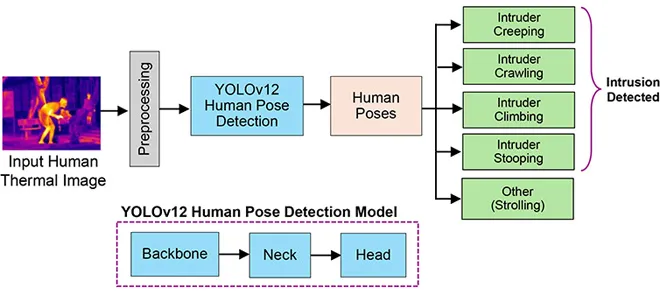
Accurate human pose recognition in thermal imagery is crucial for effective threat identification and proactive security response while minimizing false alarms. This study proposes a thermal-imaging-based framework for real-time human pose detection and classification using the You Only Look Once (YOLO) architecture.
The proposed framework addresses the limitations of RGB-based intrusion warning systems for continuous surveillance, particularly in low-visibility or poor-visual-quality conditions. Also, the proposed deep thermal image model is designed to classify five different poses of the intruders: creeping, crawling, climbing, stooping, and "other." However, the intruder's intrusion could be confirmed by detecting any one of the suspicious poses.
To optimize both classification accuracy and computational efficiency, the researchers fine-tuned the YOLOv12n architecture using the Person Detection in Intrusion Warning Systems (PDIWS) dataset. A comprehensive evaluation was conducted to assess various YOLO variants for thermal image-based intruder detection. The results showed that the fine-tuned YOLOv12n model outperformed several state-of-the-art methods, achieving a precision of 94.1%, a recall of 95.3%, and a mean average precision (mAP@50) of 97.7% with class-wise accuracy exceeding 95% across all categories.
The robustness of the YOLOv12n model was tested under various image degradation conditions, including additive noise, motion blur, and geometric transformations. Hypothesis testing using p-value analysis confirmed that variations in performance were statistically significant across different levels of perturbation. The framework was deployed on several platforms, such as the Raspberry Pi 5 for edge computing, the NVIDIA Jetson Orin Nano for edge-embedded applications, and a desktop PC with an NVIDIA RTX 3090 GPU, to evaluate its feasibility and class-wise accuracy.
The results showed a low inference time and higher accuracy, enabling the fine-tuned YOLOv12n model to be suitable for real-time deployment. The research highlights the positive impact of data augmentation on improving generalization performance, especially for the fine-tuned YOLOv12n model. However, the classification accuracy for the “other” category was relatively low. To improve the low accuracy in the “other” category, the researchers are exploring focal loss modifications and implementing a two-stage detection system. In this system, high-confidence intrusion detections trigger immediate alerts, while “other” categories require operator review.
While this research focuses on YOLO architectures due to their trade-off between accuracy and computational efficiency, future research will explore transformer-based and hybrid deep learning models for detecting intruder poses. Extensive validation will be conducted across diverse real-world thermal datasets to improve the generalizability and robustness of thermal-based intrusion detection systems, ultimately leading to fewer false alarms.