



Tactile Sensor Elements Based on Commercial Components: An Experimental Comparison
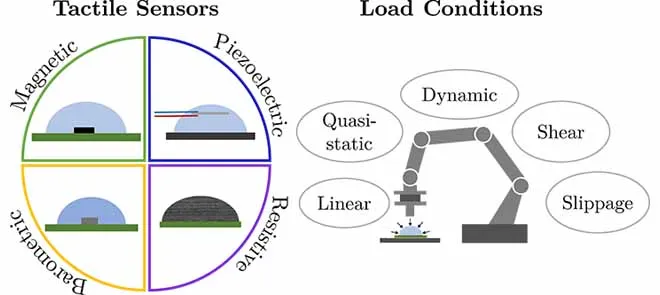
Tactile sensing remains a significant challenge in robotics due to the difficulty of integrating multimodal sensing capabilities, ensuring scalability, achieving low-cost manufacturing, and conducting robust experimental validation within a unified sensing framework. This work addresses the lack of comparability among tactile sensor prototypes by experimentally evaluating nine tactile sensor elements based on commercially available components and four commonly used transduction principles: barometric, magnetic, piezoresistive, and piezoelectric.
To ensure reproducibility and facilitate direct comparison, this study introduces a robot-driven experimental setup that can apply controlled normal and shear forces under representative robotic grasping conditions. The setup consists of a Franka Emika Panda robot and a three-axis reference force sensor, connected through a real-time EtherCAT-based data acquisition architecture operating at 1 kHz. The experimental protocol evaluates sensor behavior under various conditions, including linear loading, dynamic loading, quasi-static interaction, shear force application, and sliding conditions.
The investigated prototypes included two 3D-printed piezoresistive sensors manufactured from conductive Thermoplastic Polyurethane (TPU) filament, two Hall-effect magnetic sensors with embedded cylindrical magnets, one polyvinylidene fluoride (PVDF)-based piezoelectric sensor, and four variants of barometric sensors based on BMP384 and BMP390 micro-electromechanical systems (MEMS) pressure integrated circuits (ICs). These barometric sensors are encapsulated in silicone matrices with different shore hardness and varying housing configurations.
Experimental results demonstrate distinct performance trade-offs among the transduction principles. During linear loading experiments, the barometric prototype Baro384-50 achieved the highest overall accuracy, with a mean force deviation of 0.13 N ± 0.11 N, corresponding to approximately 2.4% of the sensor range. It also exhibited low hysteresis and minimal drift compared to other prototypes. However, dynamic and quasi-static experiments revealed delayed responses in barometric sensors due to viscoelastic deformation of the silicon, which reduced performance under rapidly changing load conditions.
Magnetic Hall-based sensors demonstrated the most balanced multimodal performance across all experiments. Although their static accuracy was lower than that of the best-performing barometric sensor, they maintained stable behavior during dynamic loading and quasi-static interactions. In addition, the magnetic sensors enabled three-axis force estimation, with successful calibration of the normal and shear components. During sliding experiments, the Hall-based sensor exhibited a response delay of approximately 50 ms, outperforming the piezoelectric prototype and approaching the timing of human tactile reflexes.
The piezoresistive sensors fabricated from conductive filaments enabled accessible, low-cost tactile sensing with customizable morphologies. Nevertheless, both prototypes exhibited substantial drift, hysteresis, and relaxation effects, limiting their suitability for accurate quantitative force estimation under quasi-static conditions. Their behavior, instead, supports qualitative contact detection and large-area tactile skin implementations. The piezoelectric prototype exhibited characteristic velocity-dependent voltage peaks and demonstrated sensitivity to dynamic contact events and slip phenomena but lacked stable static force-sensing capability.
The comparison presented here highlights the importance of evaluating tactile sensing technologies under standardized and application-relevant loading scenarios. The proposed methodology and openly reproducible framework provide a foundation for future benchmarking and sensor fusion research, enabling more systematic development of tactile systems for robotic manipulation and human-inspired sensing applications.