



Smart Diaper With Printed Capacitive Sensors and Integrated Front-End to Monitor Voided Fluid Volume
Urinary incontinence is a common issue in elderly care. In many hospitals and care homes, caregivers often need to manually check adult diapers and weigh used ones to estimate the volume of fluid voided. This process is time-consuming, uncomfortable for the patient, and can delay diaper changes. Prolonged exposure to wet diapers can also irritate the skin and increase the risk of infection. A practical smart diaper could therefore improve comfort, hygiene, and care efficiency.
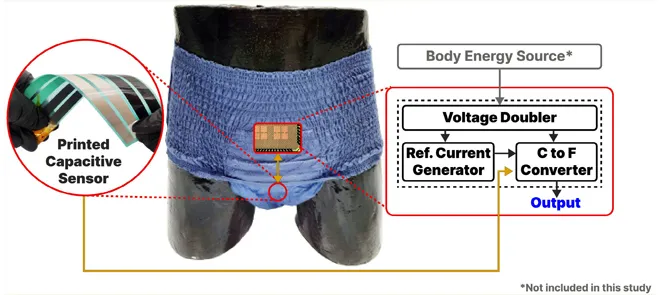
This study introduces a smart adult diaper concept that incorporates printed capacitive sensors and a custom integrated front-end circuit to detect urination events and estimate fluid volume. The sensing element is a flexible coplanar capacitive sensor printed on a thin plastic substrate using either silver or carbon conductive ink. The sensor is placed inside the diaper, beneath the absorbent layer, allowing it to detect changes in liquid absorption directly.
When the diaper is dry, the surrounding material exhibits relatively low dielectric response. However, when urine or water enters the diaper, the sensor's capacitance increases significantly because liquid has a much higher permittivity.
This change in capacitance is then converted into an output frequency by the electronic front-end. A significant contribution of this work is the design of an ultralow-power application-specific integrated circuit (ASIC) fabricated in 65-nm CMOS technology. This circuit features a capacitance-to-frequency converter, a stable current reference, and a voltage doubler designed for energy-harvesting applications.
Instead of relying on bulky off-the-shelf electronics or frequent battery replacement, the front-end was designed to consume only microwatts of power. The maximum measured power consumption was 3.05 µW, making the system suitable for future battery-less smart diapers powered by body-related energy sources, such as heat or urine-based energy harvesters.
The system was tested in several controlled laboratory scenarios. First, the printed sensors were placed in a jar as the water volume was increased in steps, confirming that the circuit's output frequency decreased as the liquid volume increased.
The sensors were then integrated into adult diapers and tested with water and synthetic urine. Both silver- and carbon-printed sensors clearly distinguished between dry and wet diaper states. When 300 mL of liquid was poured, the output frequency dropped from above 8 kHz in the dry state to below 1 kHz in the wet state. The system also quantified the voided volume in increments of 50 mL, with the carbon sensor showing an output frequency range of approximately 5 to 0.7 kHz for volumes of synthetic urine from 50 to 300 mL.
Additional tests conducted on a humanoid torso in a lying position showed that the system could detect intermittent urination events, which are useful for monitoring bladder patterns.
The results show that integrating printed capacitive sensors with a specialized low-power integrated circuit can lead to the development of disposable, low-cost, and sustainable smart diapers. Carbon ink is especially appealing because it delivers performance comparable to silver while being more economical and environmentally friendly. Future work will focus on improving volume accuracy, incorporating compensation sensors, roll-to-roll manufacturing, and achieving fully battery-less operation through energy harvesting.