



Simultaneous Recognition of Hand Gestures, Grasping Force, and Hand Aperture Using a Wearable Displacement Myography System
Interpreting hand movements through the activity of forearm muscles is important for understanding human intention. This understanding could lead to advancements in applications such as prosthetic control, rehabilitation, and human–machine interfaces. Most existing systems rely on surface electromyography (sEMG), which estimates hand movements by measuring muscle electrical activity. Although widely used, EMG performance can be affected by several factors, including sweat, electrode placement, and electrical interference.
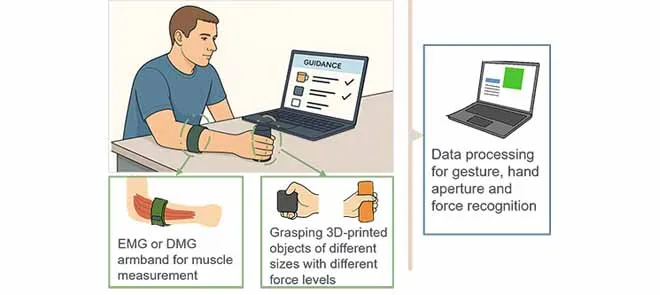
This study presents a novel displacement myography (DMG)-based wearable system, a sensing approach that simultaneously classifies hand aperture, gesture type, and grasping force during a single grasp. Simultaneous recognition of hand muscle movements is crucial for applications requiring accurate hand control, such as prosthetics, rehabilitation assessments, immersive virtual reality interactions, gaming, and human-machine interfaces. The researchers used the MyoLog armband, a flexible wearable device containing an array of miniature magnetic sensors positioned around the forearm. It measures the physical deformation of the forearm muscles during contraction. Any changes in muscle shape alter the magnetic field detected by the sensors, creating characteristic patterns associated with various hand movements.
The study addresses a more complex and realistic hand-control problem than conventional gesture recognition methods. Rather than merely identifying the type of grasp, the system simultaneously classifies the grasp type, grip force, and hand aperture (the extent to which the hand is open or closed). This functionality is important for tasks that involve manipulating objects of varying sizes and applying the appropriate levels of force.
Thirteen participants performed pinch, key, and power grasps using objects of different sizes while exerting four levels of force. The experiments generated 33 unique hand configurations. Data were collected using both the MyoLog DMG system and a conventional EMG setup, allowing for a direct comparison between the two sensing modalities under identical conditions.
In a comparison of various machine learning classifiers, DMG consistently outperformed EMG. The best DMG model achieved an average classification accuracy of 93%, compared to 64% for EMG. Analysis of the recorded signals showed that DMG produced more clearly separated classes, making it easier to distinguish between various hand configurations. In addition, high performance was maintained even when the number of DMG sensing modules was reduced, indicating that this approach is robust and does not depend on a large array of sensors.
DMG proved highly effective in identifying various hand aperture levels, achieving nearly 98% accuracy in some cases. It also demonstrated strong performance in recognizing force levels. These results indicate that measurements of muscle deformation provide valuable insights into both hand posture and interaction forces.
The findings show that DMG can provide a practical alternative to EMG for decoding complex hand intentions. Its compact, wearable, user-friendly design, simple signal-processing requirements, and compatibility with electrical stimulation make it a viable option compared to existing technologies, making DMG a promising advancement for prosthetics, rehabilitation, and human–machine interface systems.