



Simple Electrical Detection of Hydroquinone Based on DNA-Degradation-Induced Dielectrophoretic Change
Hydroquinone (HQ) is an aromatic compound commonly found in industrial processes, cosmetics, and residues from tobacco smoke. Due to its reducing properties, HQ has the potential to damage Deoxyribonucleic Acid (DNA) and has been linked with an increased risk of cancer. Hence, detecting HQ in environmental and biological samples is important for health and safety assessments.
Conventional methods for detecting HQ, such as high-performance liquid chromatography (HPLC) and electrochemical sensors, are highly sensitive but have some major disadvantages. These methods often require expensive instrumentation, complex electrode modifications, and time-consuming procedures. These limitations hinder their use for rapid, on-site monitoring, particularly for environmental screening and occupational health assessments.
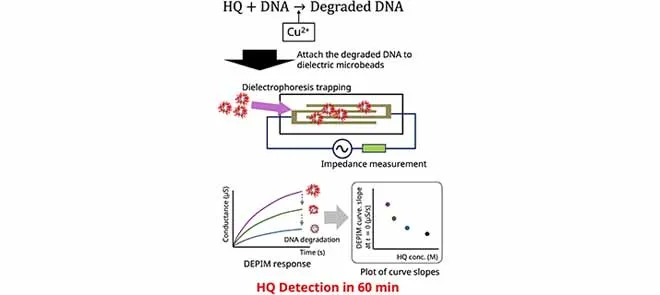
This study presents a simple and rapid electrical detection method based on HQ-induced DNA degradation combined with dielectrophoretic impedance measurement (DEPIM). The method converts a chemical reaction into a measurable electrical signal by exploiting the electrokinetic behavior of DNA-labeled microbeads. This approach eliminates the need for conventional redox-based sensing and the complexities involved in sensor fabrication.
The detection principle consists of three steps. First, DNA molecules are incubated with HQ, resulting in DNA degradation via a redox process involving benzoquinone intermediates. Second, the degraded DNA is immobilized onto dielectric microbeads. Third, the dielectrophoretic behavior of the DNA-labeled microbeads is analyzed using DEPIM. Through this process, changes in electrical impedance reflect the amount of remaining DNA, as the dielectrophoretic response depends on the quantity of attached DNA.
The introduction of copper ions significantly accelerates HQ-induced DNA degradation. This acceleration shortens the reaction time from several hours to approximately 30 minutes, enabling rapid detection of HQ. As a result, the entire detection process, including reaction, labeling, and measurement, can be completed within approximately one hour.
The proposed method has a detection limit of 50 µM and demonstrated a clear correlation between HQ concentration and the DEPIM response. Although this sensitivity is lower than that of some conventional analytical techniques, it is adequate for practical applications, such as monitoring HQ levels in biological fluids, where concentrations may reach several tens of micromolar during occupational exposure.
The method shows good selectivity as structural isomers of HQ, such as catechol and resorcinol, produce significantly weaker responses. This confirms the specificity of HQ-induced DNA degradation. Furthermore, the method's robustness was confirmed by successful detection in artificial urine, showcasing its effectiveness with complex sample matrices.
This approach offers a low-cost and straightforward alternative to traditional detection techniques, as it does not require sophisticated instrumentation or electrode modification. Instead, it relies on physical signal transduction via dielectrophoretic behavior, introducing a novel sensing paradigm for genotoxic compounds.
This method has strong potential for applications in environmental monitoring, occupational health assessment, and evaluation of third-hand smoke contamination. By enabling rapid, accessible detection of HQ, a harmful phenolic compound, this approach improves risk assessment and supports preventive strategies in both public and workplace settings.