



Seamless Mobile Indoor Navigation With VLP-PDR
Indoor positioning systems (IPS) are increasingly in demand, especially for exploring indoor public spaces such as museums and exhibition centers, as Global Positioning System (GPS) signals often weaken or fail indoors. These indoor positioning systems aim to enhance users' experience by enabling smooth, effortless indoor navigation. However, each technology used in IPS has its own limitations.
For example, visible light positioning (VLP) offers high accuracy by detecting information emitted by smart LED luminaires using the smartphone camera. However, it can be a limitation in some settings as VLP requires direct line-of-sight to these light sources. On the other hand, pedestrian dead reckoning (PDR) estimates the user's trajectory by analyzing their walking patterns through the phone's inertial sensors. While PDR enables continuous tracking of steps and movements, it tends to accumulate errors over time, especially due to environmental interference.
To address these limitations, this work presents an Android mobile application that integrates these two complementary technologies, VLP and PDR, to provide a seamless, highly accurate indoor navigation solution.
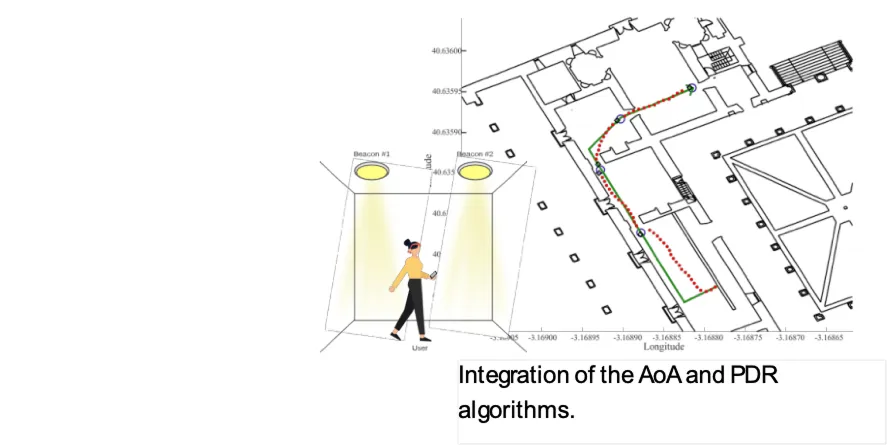
The system architecture operates as follows: the PDR algorithm continuously estimates the user’s position by analyzing their steps and movement direction. Simultaneously, when the phone’s camera captures optical information emitted from an LED luminaire with a known location, the system decodes its identifier. It then applies a pinhole camera model to compute the Angle of Arrival (AoA). This calculation compensates for possible phone tilts and determines the user’s precise position.
The key innovation of this work is the fusion of VLP and PDR methods, leveraging the accuracy of VLP to reset and correct the drift that accumulates in the PDR system. Whenever reliable light signals are available, the system uses VLP as an absolute positioning reference. However, when VLP signals are blocked or unavailable, PDR provides continuous tracking.
The system uses signal processing to extract location data from LED transmissions, a data fusion algorithm to combine inputs from multiple data streams, and an error-correction mechanism to correct PDR drift with periodic VLP updates, maintaining uninterrupted location updates even during signal loss and ensuring accuracy and continuity.
To assess the system's robustness, experimental tests were conducted in both controlled laboratory settings and in a real-world environment at the Guadalajara Museum. The test also considered factors such as device orientation, walking speed, and environmental changes. When evaluated independently, the static VLP system achieved a mean error of 10.64 cm, whereas the standalone PDR showed deviations of up to 3 meters. However, when both algorithms were combined, the mean error across the complete trajectory was significantly reduced to just 0.85 meters.
By calibrating sensor data and optimizing fusion strategies, the system demonstrated significant improvements in positioning accuracy and reliable performance across complex layouts, even under partial lighting. It operates effectively without specialized hardware, relying instead on standard smartphone sensors and existing lighting infrastructure. Even when light signals fade, step-tracking continues to send signals without interruption, providing users with a reliable indoor navigation system, especially where GPS is ineffective.