



Poriferous Flexible Plasmonic Nanocolumns-Based Micro-Spot Sensing of Mercury Ion via Enhanced Fluorescence
Environmental pollution from heavy metal ions is a major concern because many of these ions are highly toxic and nonbiodegradable. Mercury (Hg2+) ions are among the most harmful pollutants in water, soil, and food, raising concerns for human and environmental health.
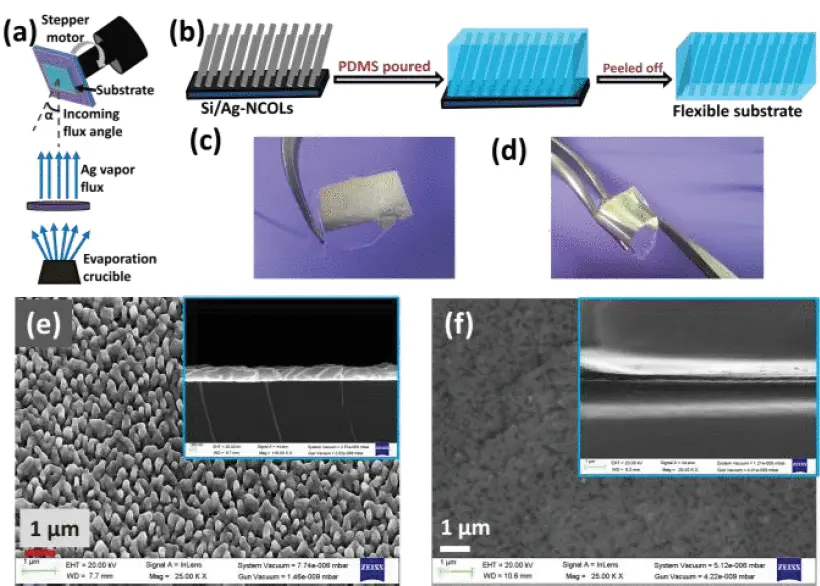
This work presents a comprehensive study of fluorescence signal modulation (quenching or enhancement) based on poriferous flexible silver nanocolumns (Ag-NCOLs) embedded in a polydimethylsiloxane (PDMS) platform for Hg2+ ion detection. The plasmonic sensor was fabricated through a templating-assisted approach, enabling the development of a flexible, porous, and highly sensitive plasmonic nSTF sensing substrate.
The proposed sensor operates in dual-sensing (dry and wet) modes, providing an effective strategy for ultrasensitive and reliable detection of Hg2+ ions. The sensing mechanism relies on the fluorescence response of rhodamine-6G (R6G) molecules immobilized on Ag-NCOLs in the presence of Hg2+ ions and cystamine (Cys). It demonstrated remarkable fluorescence signal modulation depending on the sensing environment.
In dry mode, the fluorescence intensity gradually increased with increasing concentration of Hg2+ ions while keeping the concentration of Cys fixed. Similarly, enhancement in fluorescence was observed with increasing concentration of Cys. In contrast, the wet mode exhibited distinctly different sensing behaviour, where the fluorescence signal experienced gradual quenching with increasing Hg2+ ion concentration at fixed Cys concentration, whereas increasing the concentration of Cys enhanced the fluorescence signal.
These contrasting responses showed that effective sensing is dependent on the detection of analyte and the operational mode of sensing. By changing the sensing environment from dry to wet mode, the underlying sensing physics changes significantly, resulting in distinct response curves. Furthermore, the use of two sensing modes provides dual verification, substantially improving the reliability and accuracy of Hg2+ ion detection.
To further understand the fluorescence enhancement and quenching mechanisms, the researchers also applied complementary characterization techniques, such as fluorescence lifetime spectroscopy (FLS), Fourier transform infrared (FTIR) spectroscopy, and X-ray photoelectron spectroscopy (XPS). These techniques provided valuable insight into the interaction between Hg2+ ions, Cys molecules, and the Ag-NCOL surface, clearly explaining the modulation of fluorescence signals in both sensing modes.
Additional control experiments were also carried out by varying the concentration of Cys in both dry and wet modes, along with the selective detection of Hg2+ ions against other analytes and examining the reusability and long-term stability of the fabricated sensor. The sensor exhibited exceptional performance with an estimated limit of detection (LoD) of 10 fM and 5 fM for dry and wet modes, respectively, over a wide dynamic range from 0.001 to 100 pM.
This fluorescence sensing platform offers a highly sensitive, selective, and efficient approach for Hg2+ ion detection. The dual-mode sensing capability enhances reliability while providing a deeper understanding of fluorescence modulation mechanisms. The sensor's sensitivity, rapid response time, excellent selectivity for Hg2+ ions, and reusability demonstrate its practical applicability in real-world scenarios and for environmental monitoring, water treatment, food safety, and biomedical fields where accurate and rapid detection of mercury contamination is essential.