



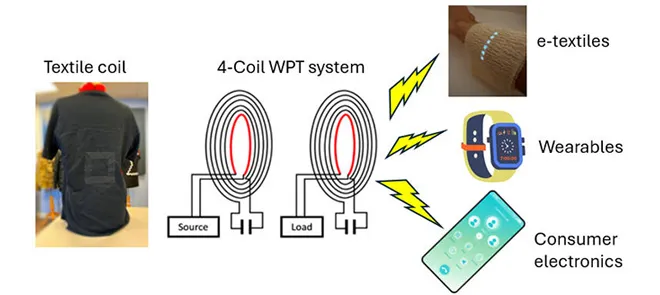
Performance Comparison of Two-, Three-, and Four-Coil E-Textile Wireless Power Transfer Systems
Electronic textiles (e-textiles) and smart clothing can be used to monitor an individual’s health or environment. However, one major challenge is supplying power to these devices. Currently, e-textiles are universally powered by traditional batteries, which tend to be bulky, rigid, inconvenient, and incompatible with fabrics, and they cannot be washed.
Wireless power transfer (WPT) could offer a solution by powering e-textiles and smart clothing directly, or by recharging textile batteries or supercapacitors. This could be done by placing the garments in a wardrobe or drawer that has a suitable power transmitter.
This paper explores the use of inductive near-field WPT to transfer electrical energy using flexible square coils, each 15 cm wide, fabricated on a textile with copper Litz wire through a standard embroidery process. The effectiveness of inductive WPT depends on the quality factor of the coils. Also, constraints in the textile assembly process can reduce their overall efficiency. However, more complex system configurations can help mitigate these issues. Hence, this work compares three systems using two-coil, three-coil, and four-coil configurations to identify the most reliable configurations.
The researchers designed these three systems to operate at a standard frequency of 6.78 MHz and tested them under real-world conditions. These conditions include variations in coil positioning that can affect power transfer, such as differing distances between coils, axial and angular misalignment when coils are not perfectly aligned or parallel, bending or folding of the fabric and coils, and the effect of repeated machine washing.
All systems demonstrated the ability to transfer power and energy at distances beyond 20 cm and achieved peak efficiencies around 78%. At short distances, all systems performed well; each had an optimal distance (around 9–11 cm) at which performance was highest. At longer distances, the four-coil system performed best, while the two-coil system lost efficiency more rapidly with increasing distance.
As the transmitter and receiver coils become more misaligned, their efficiency decreases. The reduction in efficiency with axial misalignment was fairly linear, whereas angular misalignment led to a sharp reduction in efficiency beyond around 45 °. Similarly, efficiency decreased as bending increased; however, in all cases, the four-coil system demonstrated the greatest tolerance to misalignment and bending.
One significant challenge was the durability of washing, as efficiency can decline by 50% or more after multiple wash cycles. The decline is attributed to changes in coil geometry and resistance.
The system also successfully demonstrated its ability to charge a capacitor, simulating energy storage for practical applications, and to charge a smartphone. The four-coil system achieved the fastest charging rate and generated a capacitor voltage approximately twice that of the two- and three-coil systems.
This work shows that inductive near-field WPT in clothing is feasible and promising, with the four-coil system generally being the most effective option in practical scenarios. However, in the future, further research on coil durability and resistance to washing is required to improve materials and manufacturing methods and to develop efficient, flexible, and self-powered wearable sensor systems.