



Miniaturized Carbon-Cloth/TiO2 Nanofiber-Based Electrochemical Sensor for Simultaneous Detection of Dopamine and Insulin
The future of healthcare is moving toward sensing technologies that can provide information continuously, rapidly, and as close to the patient as possible. However, monitoring multiple biomarkers simultaneously remains challenging, especially when the target molecules exhibit markedly different physicochemical and electrochemical properties.
Dopamine and insulin are two important biomarkers that illustrate this issue. While insulin is a hormone that regulates blood glucose levels by helping cells take up glucose for energy production, dopamine is a key neurotransmitter involved in neurological functions and influences insulin secretion, sensitivity, and glucose metabolism. Hence, both insulin and dopamine are essential for effective diabetes management. Bringing these two biomarkers onto a single, compact sensing platform provides a valuable step toward more integrated and personalized health monitoring.
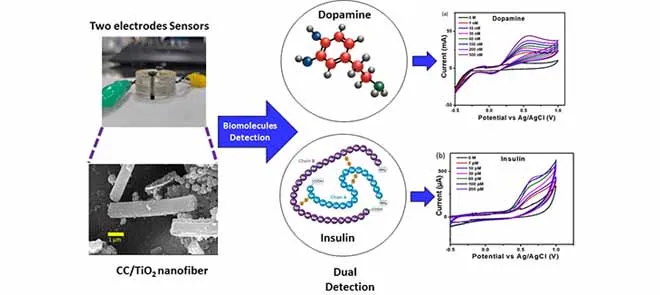
This work introduces a miniaturized carbon cloth (CC)/ titanium dioxide (TiO₂) nanofiber-based electrochemical sensor designed for the simultaneous detection of dopamine and insulin. Rather than relying on separate sensing interfaces, this platform leverages the intrinsic differences in the electrochemical behavior of these two biomolecules, thereby producing distinct, well-separated responses on a single sensing substrate.
The sensing architecture combines the advantages of carbon cloth with a surface made of titanium dioxide (TiO₂) nanofibers. The carbon cloth provides a conductive, mechanically robust, and cost-effective foundation, while the nanostructured TiO₂ layer enhances the electrochemical interface for biomolecular interactions. This surface engineering significantly improves sensing capabilities compared to bare carbon cloth, highlighting the importance of customizing the electrode interface for multiplexed biomarker detection.
A particularly important feature of the platform is its ability to distinguish between the two analytes based on their distinct electrochemical mechanisms. Dopamine, as a relatively small molecule, exhibits rapid diffusion-controlled electron-transfer behavior. In contrast, the larger insulin molecule exhibits adsorption-assisted kinetics and responds at a higher oxidation potential. These differences create clearly distinguishable electrochemical signatures, enabling simultaneous detection without requiring independent electrodes for each biomarker.
The electrochemical performance of the platform was investigated using cyclic voltammetry and chronoamperometry. The successful development of the sensing interface was further supported through FTIR, XPS, morphological characterization, and electrochemical studies using K₃Fe(CN)₆ as a redox probe. Together, these investigations establish the successful modification of the carbon cloth surface and its resulting electrochemical advantages.
The significance of this work extends beyond the detection of two individual biomolecules. It demonstrates a strategy for transforming a simple, low-cost substrate into a multiplexed sensing interface capable of differentiating chemically distinct biomarkers on a single miniaturized platform. The combination of biocompatibility, structural robustness, enhanced electrocatalytic activity, and plug-and-play operation makes the approach attractive for the next generation of portable and personalized sensing technologies.
Ultimately, this platform points toward a broader vision of an integrated approach to biomarker monitoring, in which multiple physiological signals can be measured using compact sensing systems rather than relying solely on isolated laboratory-based assays. Such technologies could become important building blocks for real-time health assessment, personalized healthcare, and future point-of-care diagnostic platforms.