



Millimeter-Wave Metamaterial-Based Strain Sensor Concept
Strain measurement, which involves measuring deformation, is a central task of sensor technology in mechanics and engineering. The measurement is crucial for structural health monitoring of bridges, rail tracks, and aircraft wings, and forms the basis of force and torque sensing. When a force acts on a rigid body, it produces deformation. Measuring this deformation makes it possible to calculate the applied force. This principle is fundamental to the operation of force and torque transducers.
One particularly demanding application is strain measurement on the rotating axle of a drivetrain. These axles are designed to be highly rigid, which results in only minute deformations. Also, since the axle rotates, the conventional wired sensors cannot be used for data transmission. This situation creates a strong demand for telemetric strain measurement.
In this paper, the researchers present a telemetric strain measurement concept based on an elastic metamaterial. These metamaterials are engineered to operate at millimeter-wave frequencies to detect mechanical strain. The metamaterial consists of pairs of copper arcs embedded in a 0.2 mm sheet of thermoplastic polyurethane (TPU). Each copper arc behaves like a miniaturized antenna; when irradiated with electromagnetic waves, the reflected signal is shaped by its resonant behavior. The dimensions are selected so that the resonance occurs at approximately 70 GHz (a wavelength of about 4.3 mm). This frequency band is beneficial because compact, low-cost transceiver chips are readily available for it.
The sensor concept exploits the mutual coupling between the two arcs in each pair. When strain is applied, the elastic TPU stretches, causing a shift in the relative positions of the arcs. This shift alters the resonance of the metamaterial and, consequently, its reflectivity. As a result, the metamaterial effectively converts mechanical strain directly into a change in the reflectivity of electromagnetic waves.
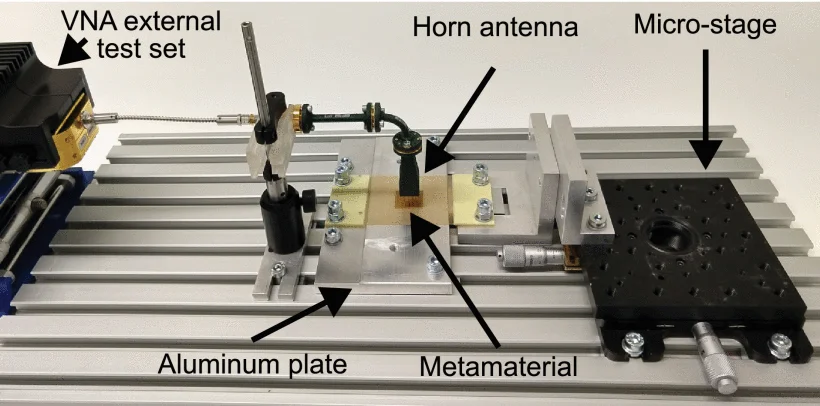
The researchers developed a semi-analytical model that describes this sensor effect and demonstrates that changes in the density of TPU due to stretching contribute significantly to the sensor's sensitivity. To validate the concept experimentally, a metamaterial comprising a 20×20 array of copper arc pairs was manufactured. Its sensor response was characterized using a vector network analyzer, and frequency spectra were recorded in the corresponding millimeter-wave band. The measured sensitivity, (11,618 ± 78) Hz/microstrain, compares well with recent findings for metamaterial-based strain sensors reported in the literature.
A key advantage of this design is the significant difference in elasticity between copper and TPU. Under strain, the copper structures deform only negligibly, thereby preventing delamination and abrasion. This characteristic is important for long-term durability. The concept also supports the development of lightweight, compact sensors for structural health monitoring, aerospace components, and smart engineering systems, enabling sensitive detection of small deformations.
Overall, the results indicate that resonant copper structures embedded in elastic TPU provide a viable basis for telemetric strain measurement. The semi-analytical model developed by the team describes the underlying sensor effect and provides a foundation for the further development and optimization of metamaterial-based strain sensors.