



Gold Nanoparticle-Assisted Multiharmonic and Multivariate QCM Sensing of miRNA-21
Cancer diagnosis is increasingly moving toward minimally invasive approaches in which a simple biological sample can provide valuable information about disease development, progression, and treatment response. Among the molecular signals gaining significant attention are microRNAs (miRNAs), which are small regulatory RNA molecules involved in cellular regulation and disease progression. MicroRNA-21 (miRNA-21) serves as a significant biomarker for detecting diseases such as cancer, cardiovascular disease, and inflammatory disorders. Tumor-specific miRNA expression profiles can help define molecular subtypes, track treatment effectiveness, and correlate with patient survival rates. Conventional detection methods are laboratory-based, time-consuming, and not convenient for point-of-care applications.
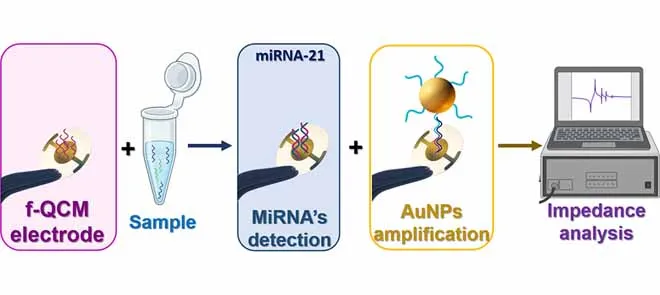
However, detecting these biomarkers remains a major technological challenge because they exist at extremely low concentrations and are embedded in complex biological environments that can compromise reliable analysis. In this work, the researchers present a biosensing strategy for detecting miRNA-21 that utilizes gold nanoparticle-assisted multiharmonic and multivariate quartz crystal microbalance (QCM). This innovative method combines nanotechnology with multivariate signal analysis. By integrating gold nanoparticles (AuNPs) with a QCM biosensor, the proposed platform enables sensitive, label-free, and real-time monitoring of molecular recognition events.
The key innovation of this approach lies in combining gold nanoparticle (AuNP)-assisted biochemical amplification with multiharmonic and multivariate exploitation of QCM responses. Unlike conventional QCM approaches that primarily focus on single-frequency tracking, this strategy analyzes multiple resonance modes along with other parameters, including frequency, amplitude, phase, and impedance, which are analyzed simultaneously. This comprehensive analysis provides a more complete characterization of biomolecular interactions by capturing both mass-loading and viscoelastic effects associated with nucleic acid hybridization.
By integrating AuNP-assisted signal enhancement with multivariate analysis of QCM responses, the platform improves detection sensitivity and enables reliable identification of miRNA-21, surpassing conventional QCM approaches. The combination of acoustic sensing principles, nanostructured materials, and advanced signal analysis provides an effective strategy to address existing limitations in biomarker detection.
Using multivariate analysis alone, the effective limit of detection (LoD) for miRNA-21 is reduced from approximately 10 nM to 100 pM. The integration of an AuNP-assisted sandwich hybridization assay further enhances the sensor response by approximately 1.5 times, ultimately achieving a final LoD of 1 pM over a dynamic range of 1 pM to 10 µM. Specificity assays performed with non-target miRNAs (miRNA-145 and miRNA-9) show minimal cross-reactivity, confirming the effectiveness of sequence-selective hybridization.
In addition to detecting miRNA-21, this study highlights the potential of transitioning from single-parameter measurements to intelligent sensing systems capable of extracting more detailed information from complex biological interactions. These multivariate sensing strategies could support future liquid biopsy applications by enabling more sensitive and reliable analysis of biomarkers, which is crucial for early diagnosis and personalized medicine.
Ultimately, this research demonstrates how the synergy between nanomaterials and advanced QCM analysis can extend the sensing capabilities of conventional mass-sensitive sensors for next-generation biomarker detection.