



Estimating Internal and Reaction Forces in Cable Slabs Using High-Speed Imaging
In precision motion systems, such as wafer scanners used in semiconductor manufacturing, bundled assemblies of power cables, signal lines, and cooling hoses form a cable slab. The cable slab connects the moving cart to the stationary frame. As the cart moves, the cable slab bends and deforms, producing reaction forces that act as unmodeled disturbances on the positioning loop. These forces contribute to tracking errors and can excite flexible modes in the mechanical structure. However, direct measurement of these forces using load cells is often impractical in production environments.
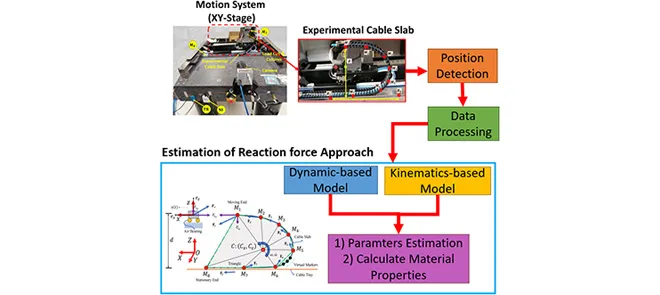
This paper introduces a non-intrusive method for estimating the cable slab’s internal and reaction forces using a calibrated high-speed camera (HSC) operating at 100 frames per second. Eight circular markers are attached to one side of the cable slab, and their positions are extracted offline from recorded images using MATLAB’s image processing tools. A global nearest neighbor algorithm handles frame-to-frame marker association. After lens distortion correction and coordinate transformation via a checkerboard-based camera calibration (mean re-projection error of 0.35 pixels), the marker’s velocities and accelerations are calculated using numerical differentiation.
Two modeling approaches were developed. The first is a dynamics-driven model based on the Voigt viscoelastic formulation, where each cable slab segment between adjacent markers is treated as a lumped mass-spring-damper element. Tension forces are written as linear functions of strain, and viscous damping forces depend on the strain rate. The researchers obtained an aggregated expression for the reaction force, expressed in terms of the composite material properties, including density, Young’s modulus (E), and the internal damping coefficient, by summing the dynamics of all segments across the markers.
The second is a kinematics-driven model, in which the instantaneous center of rotation (CoR) of the marker polygon is computed using spatial analysis in each frame. From the CoR, the angular velocity of the cable slab is estimated as a weighted average across markers, and the contact-point acceleration is expressed relative to the CoR. Using Newton’s second law, the reaction force is calculated using two adjustable parameters: a scaling factor reflecting the apparent mass seen by the cart, and a preload term.
Both models were tested on an A-322 PIglide HS planar scanner with air-bearing levitation across 15 cyclic tests (stroke lengths of 250 and 500 mm, velocities up to 500 mm/s, accelerations up to 2000 mm/s²) and 3 acyclic tests. Parameters were manually tuned, with the dynamics-based material parameters showing minimal variation across operating conditions, as expected for intrinsic physical properties. The average root-mean-square error (RMSE) between estimated and load-cell-measured forces was 1.19 N for the dynamics-driven model and 1.55 N for the kinematics-driven model.
The strain patterns obtained from the dynamics-driven model enable visualization of segment-level loading during cyclic operation, which may support fatigue prediction. As more data is collected, neural networks may outperform cameras at predicting marker position during normal operation, eliminating the need for both load cells and continuous imaging. Future work targets automated parameter identification and increased marker counts via virtual markers interpolated from spline-fitted bend geometries.