



DistillH-Mamba: A Hypergraph-Mamba-Based Knowledge Distillation Model for Efficient Impact Fall Detection
Falls, especially among the elderly population, are the second leading cause of accidental deaths worldwide. Though fall detection systems exist, accurately detecting impact, i.e., the moment of hitting the ground, remains challenging. Detecting impact during a fall is crucial for determining its severity. This distinction is important for expediting medical intervention, determining the duration of hospitalization, and the recovery period. However, existing deep learning models often bypass this fine-grained localization task. They also rely on complex architectures that incur higher computational costs, making real-time deployment on resource-constrained devices more difficult.
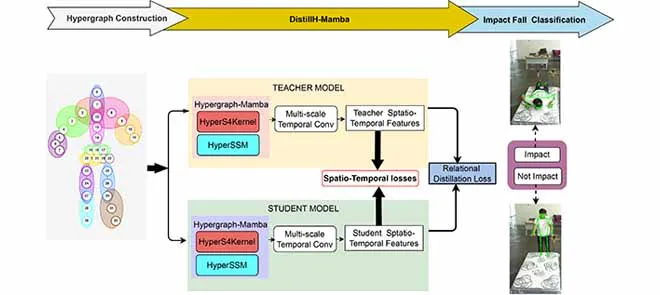
Standard graph-based AI models represent the skeleton as a set of joint pairs (e.g., shoulder–elbow, hip–knee). However, it can overlook the richer coordination that unfolds across groups of joints at the moment of impact. To overcome this limitation, this paper introduces Distill-Mamba, which uses hypergraphs, a mathematical structure that allows a single edge to connect more than two vertices simultaneously. This dual representation of hypergraphs combines direct anatomical relationships and higher-order functional correlations, providing a more comprehensive representation of the body’s state at any given moment.
The researchers addressed temporal modeling using the Mamba state-space architecture, which efficiently processes long skeletal sequences with linear computational complexity. This approach outperforms traditional transformer-based methods, typically incurring quadratic costs, while remaining sensitive to abrupt changes that characterize ground contact.
However, higher accuracy alone is not sufficient when deploying the model on resource-constrained devices such as smartphones, Raspberry Pi, or wearable sensors. Hence, DistillH-Mamba serves as a promising starting point. It employs relational knowledge distillation (RKD) beginning with a large teacher model that learns the complex spatio-temporal patterns of fall impacts. Subsequently, a small, faster student model was built and trained not by mimicking raw outputs but by preserving relationships across joint features (spatial loss) and consecutive frames (temporal loss). This approach forces the student model to learn the structural logic of impact detection rather than merely learning class probabilities.
Evaluated on the 3D skeletons UP-Fall and UMAFall datasets, the DistillH-Mamba achieves 97.38% accuracy and 99.73% specificity in detecting impacts during fall accidents. It reduces false alarms, which is crucial for emergency responses where saving lives is a priority. Moreover, the student model operates at 24.8 ms per sequence, making it 73.8% faster than teacher models. With 66% fewer parameters (23.3M versus 70.1M) and a memory footprint of 93MB, it is well-suited for device-constrained deployment environments.
The model achieved an accuracy of 94.00% on the UMAFall dataset without any fine-tuning, showing its ability to generalize beyond the initial training conditions. DistillH-Mamba is a novel skeleton-based approach explicitly designed to detect the moment of impact during a fall. This distinction is crucial for clinical systems that require accurate logging of the severity and timing of a fall event. Future work will extend to multi-person scenarios, enhancing the robustness of skeleton extraction under occlusion, and validating the system using authentic fall data collected from elderly individuals in real-world environments, in collaboration with healthcare institutions.