



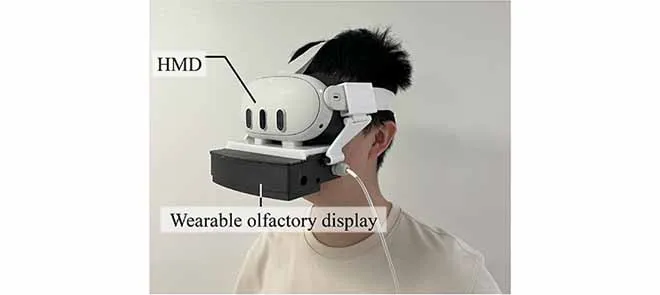
Development of an Eight-Channel Wearable Olfactory Display for Virtual Reality
Olfactory memories are among the most profound types of memory, intertwined with emotion and capable of influencing behavior. The sense of smell, or olfaction, is also vital in clinical diagnosis of conditions such as traumatic nerve damage, early neurodegenerative diseases, viral infections like COVID-19, and local sinonasal issues. Researchers are working to integrate olfactory stimuli with visual, auditory, or haptic interfaces to enhance human-computer interaction (HCI) experiences, especially in immersive applications such as virtual reality.
An olfactory display is a device designed to generate scents, and its wearable implementation can substantially enhance immersion in virtual reality (VR). The researchers have developed a compact, eight-channel wearable olfactory display that includes odor-blending capabilities. In this system, multiple micro-dispensers eject nanoliter-scale (one billionth of a liter) liquid droplets, which are then atomized simultaneously and nearly instantaneously by an ultrasonic atomizer. The resulting mist is then directed toward the user's nose by airflow generated by an external pump and a small internal fan.
Despite the significant space constraints of a wearable platform, this system successfully integrates eight channels—an impressive number for a head-mounted olfactory display. While desktop olfactory displays can accommodate many channels, increasing the number of channels in wearable devices is considerably more challenging due to size, weight, and heat dissipation constraints.
To address these challenges, this work presents specially developed compact drive circuits and dedicated adapters that integrate all components beneath a head-mounted display (HMD). Active convective cooling was also employed to reduce heat buildup from the densely packed onboard electronics. The completed device expands the range of reproducible odors by enabling a customizable recipe with eight ingredients. By atomizing and mixing multiple ingredients at the same location, the system achieves low-latency scent presentation, enabling rapid and accurate delivery of the desired odor. The use of nanoliter-scale droplets provides fine-grained control of odor intensity. To minimize odor persistence after the stimulus ends, the system actively suctions residual scent from the area in front of the nose. The suctioned air is passed through an activated-carbon filter before being released, thereby reducing unintended odor diffusion into the surrounding environment.
To demonstrate the device's effectiveness, olfactory VR content was developed for immersive applications, such as tourism promotion and product marketing. One example is a travel-experience application that allows users to visit a variety of destinations—including a forest, a lakeside setting, and a virtual alien planet—within a 360-degree audiovisual environment.
Six odor stimuli—mushroom, sulfur, orange, rose, lavender, and coffee—were embedded in the virtual scenes to enrich the multisensory experience. Ethanol was used as a solvent to dilute each odor ingredient. It was essential to keep its airborne concentration below the relevant regulatory limit. User testing confirmed that the solvent concentration remained within the permissible range. The travel-experience content has been demonstrated at numerous events, including public exhibitions and private demonstrations for invited groups.
This wearable olfactory display provides a compact, low-latency solution for olfactory augmentation in immersive media and human-computer interaction research. It shows the potential for broader applications of olfactory displays.