



Design of a Closed-Loop Wireless Power Transfer System for an Implantable Drug Delivery Device
Implantable medical devices are revolutionizing the treatment of chronic diseases, enabling continuous and unobtrusive therapies that improve patients’ quality of life. However, unlike wearable devices, implants face a fundamental limitation: operating safely within the body, where size, temperature, and energy availability are tightly constrained. Reliable power is required to enable connectivity and advanced functionalities; however, recharging an implanted battery remains a major challenge.
Wireless power transfer (WPT) offers a promising solution for delivering energy through biological tissues without physical connections. Among available techniques, near-field resonant inductive coupling (NRIC) is well suited for small, low-power implants. However, conventional systems are sensitive to variations in alignment, distance, and load conditions. In in-vivo scenarios, movement and tissue variability can cause inefficiencies, interruptions in power transfer, or unwanted heat generation, all of which are critical safety concerns.
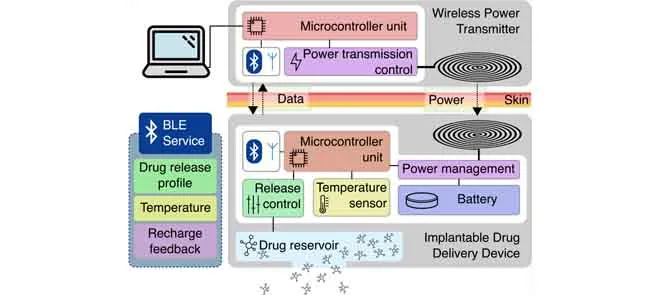
To address these challenges, the researchers developed a closed-loop wireless power transfer system that dynamically adapts to real-time operating conditions. The idea is to combine wireless power delivery with a communication link—in this case, Bluetooth Low Energy (BLE)—to continuously monitor the implant’s state and regulate the transmitted power accordingly. Instead of relying solely on fixed hardware settings, the system uses feedback from the implant to adjust the power level, ensuring both efficiency and safety.
The system was designed and validated in combination with the nanochannel drug delivery system (nDS), an implantable platform capable of controlled and tunable drug release. The implant integrates a rechargeable battery, a microcontroller with wireless connectivity, sensing capabilities, and a receiver coil for wireless power. During operation, the implant measures electrical parameters—battery voltage and rectified coil voltage—and periodically communicates this information to the external transmitter. Based on these measurements, the transmitter increases, decreases, or maintains the power, effectively behaving like an intelligent charger that adapts to changing conditions.
Experimental results demonstrate that this closed-loop approach significantly improves reliability compared to conventional methods. The system maintains continuous power transfer under challenging conditions, such as coil misalignment (up to 8 mm lateral displacement and 12° angular variation) and varying distances compatible with subcutaneous implantation. It achieves stable battery charging without interruptions and with controlled temperature rise, remaining close to the safety limit of 2 °C defined for implantable devices. Peak efficiencies above 30% were observed with optimized coil configurations while maintaining robustness across different operating conditions.
Importantly, the system is built with commercial-off-the-shelf components and requires minimal additional hardware, making it easy to integrate designs. Its effectiveness relies primarily on the control strategy rather than on complex or bulky circuitry.
This innovative approach paves the way for a new generation of connected implantable devices capable of long-term operation. By enabling safe, reliable, and adaptable wireless recharging, it reduces the need for surgical battery replacements and supports continuous therapies for extended periods. Beyond drug delivery systems, this method can be applied to a wide range of implantable sensors and therapeutic devices, advancing personalized and autonomous healthcare technologies.