



Compound Fault Diagnosis of Rolling Bearings Based on the PSD-Guided Cyclostationarity Feature Mode Decomposition
Rolling bearings are essential components in mechanical systems, and their operational integrity is vital for the safety of industrial equipment, such as high-speed trains. When these bearings develop faults, especially multiple (compound) faults, early and accurate detection is crucial to prevent unexpected breakdowns, reduce maintenance costs, and improve safety.
Machines produce vibration signals during operation, and these signals carry hidden information about their health. However, in actual operating environments, vibration signals generated by rolling bearings are often mixed with multiple components and noise. These can severely interfere with signals indicative of compound fault information, making it challenging to detect and diagnose overlapping faults.
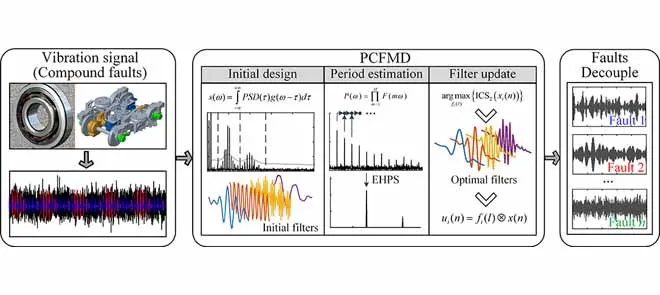
Developing a method that effectively extracts fault information and identifies the types of compound faults is essential. This paper introduces a novel approach to improve the identification of these compound faults, to make machine maintenance more reliable and efficient. The work presents a novel method called Power Spectral Density-Guided Cyclostationarity Feature Mode Decomposition (PCFMD). The main contribution of PCFMD is its efficient two-round strategy of "initialization-optimization."
The approach integrates two powerful signal-processing concepts: power spectral density (PSD) analysis and cyclostationarity-based feature extraction. Unlike manual filtering methods, PCFMD uses a smoothed Power Spectral Density (PSD) to effectively quantify the energy distribution of the vibration signal. The PSD serves as a guiding tool to emphasize the most informative frequency components of the vibration signal. This statistical approach allows the algorithm to accurately identify resonant bands where fault information is concentrated, thus providing a robust theoretical basis for initial filter design even under low signal-to-noise ratio (SNR) conditions.
After the initial filter design phase, the PCFMD incorporates the second cyclostationarity (ICS2) index to refine and optimize adaptive filters. By targeting the inherent cyclostationary characteristics of mechanical faults, PCFMD can precisely extract periodic impulses across various frequency bands. This optimization ensures that the filters converge accurately to the fault resonant frequencies without requiring exhaustive repeated iterations.
By analyzing the signal in this structured way, the method can isolate features associated with individual faults, even when they occur simultaneously. This makes it much easier to identify the type and severity of each fault. Compared to conventional diagnostic approaches, the proposed method offers enhanced clarity, improved accuracy, and stronger resistance to noise and signal interference.
The method was validated through extensive simulation and experiments to confirm its effectiveness. It shows a significant improvement in operational efficiency without compromising fault diagnosis capabilities. The experimental results indicate the effectiveness of this technique in detecting compound faults under various operating conditions.
This approach enhances diagnostic precision and supports earlier detection of problems that could lead to machine failure. It is particularly suitable for on-board embedded diagnostic terminals that have high real-time requirements, providing a new technical solution for real-time online condition monitoring of rolling bearings. This advancement enables accurate fault diagnosis in rotating machinery used in manufacturing, transportation, and energy sectors, making machine maintenance more reliable and efficient, helping to reduce downtime, lower maintenance costs, and improve operational safety.