



Broadband Electrical Matching Network for PZN-PT Single Crystal Underwater Acoustic Transducer
Broadband underwater acoustic transducers are essential components for marine exploration, underwater communication, high-resolution imaging, and anti-interference target detection. A broad operating frequency bandwidth can enhance data transmission efficiency, spatial resolution, and anti-multipath & anti-reverberation performance. However, achieving a combination of broad bandwidth, high transmitting gain, and high-power factor remains a significant challenge in high-performance transducer design.
Conventional acoustic matching primarily enhances bandwidth by introducing acoustic-matching layers or by optimizing structural modes. Traditional passive electrical matching typically relies on computer-aided design (CAD) or single-frequency impedance models to improve energy transfer efficiency near the resonant frequency. However, acoustic matching often compromises power factor efficiency despite its bandwidth extension effect. On the other hand, passive electrical matching can only support narrowband optimization and cannot maintain stable performance or expand transducer bandwidth over a wide frequency range. Therefore, it is difficult to simultaneously achieve both bandwidth expansion and a high power factor within the transducer using these two methods. This limitation affects the overall electroacoustic performance of underwater acoustic transducers.
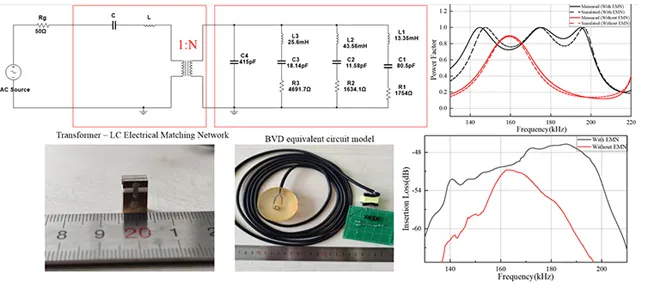
To address these critical limitations, this work introduces a novel transformer-LC broadband electrical matching network with integrated impedance transformation and wideband tuning. The transformer is employed to scale the input impedance and adjust the phase offset at the parallel resonance, effectively reducing the reactive component introduced by the transducer’s static capacitance.
Meanwhile, the LC resonant network is designed to electrically shift the resonant frequencies of the conventional transverse width (CTW) mode and the transverse resonance orthogonal beam (TROB) mode. This reduces their frequency separation and promotes multimode coupling. This synergistic mechanism reshapes the overall impedance profile, resulting in a predominantly resistive characteristic across a wide frequency range, improving the transducer bandwidth without compromising receive sensitivity and enabling stable, efficient energy transmission.
An underwater acoustic transducer was fabricated using the CTW-TROB resonant modes and driven by [011]-poled PZN-PT single crystals. The transducer's resonant frequencies, measured with an impedance analyzer, were approximately 150 kHz in CTW mode and 220 kHz in TROB mode. Based on the measured impedance data, a nonlinear regression was performed to estimate the Butterworth–Van Dyke (BVD) equivalent circuit parameters. Subsequently, a transformer-LC broadband electrical matching network was designed, constructed, and integrated for further experimental verification.
Experimental results demonstrate that the designed transformer-LC matching network significantly improves the transducer's transmission performance, effective operating bandwidth, and energy transmission efficiency. The receive sensitivity remains high without any obvious degradation. The measured electrical and acoustic responses align well with simulation predictions, confirming that the proposed method effectively overcomes the narrowband limitation of traditional passive matching methods and enables stable broadband operation of the transducer.
This work provides a practical and reliable wideband electrical matching solution for PZN-PT single-crystal underwater acoustic transducers. It can be applied to underwater communication, high-resolution sonar imaging, and marine target detection, effectively improving the bandwidth and energy-transfer efficiency of transducers. Future work will focus on enhancing high-temperature stability, suppressing parasitic parameters, and advancing integrated miniaturization to support advanced underwater sonar systems better.