



Bioinspired Tapered-Spring Turbulence Sensor for Underwater Flow Detection
Underwater robots often operate in environments where factors such as turbidity, acoustic scattering, complex terrain, and current-induced disturbances limit their vision and sonar capabilities. As a result, important hydrodynamic cues, such as vortex streets, wake transitions, shear layers, and localized turbulence, are difficult to capture using conventional sensing systems. To overcome this challenge, this work introduces a bioinspired tapered-spring turbulence sensor that provides a low-power, physically interpretable solution for detecting underwater flow.
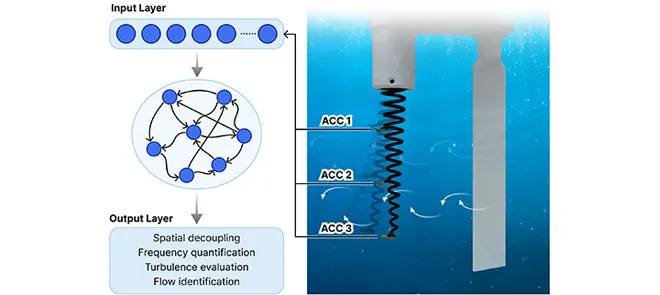
The proposed sensor is inspired by biological whisker sensing, but rather than directly replicating the external morphology of animal vibrissae, it uses a tapered helical spring as a mechanical reservoir. The spring’s graded stiffness and distributed mass profile transform incoming flow disturbances into spatially differentiated vibration patterns. Three miniature inertial measurement units (IMU) are mounted along the spring to capture position-dependent vibration responses. In this way, part of the signal processing is performed mechanically before digital analysis, thereby reducing the computational load required to recognize different flow states.
The sensor was evaluated using a controlled underwater towing-tank platform and supported by computational fluid dynamics simulations. An adjustable upstream fin was used to generate different wake conditions, ranging from relatively attached flow to periodic Kármán vortex shedding and broader turbulent structures. The experimental results indicated that the tapered spring produced a clear frequency–spatial separation, with different sensor positions responding preferentially to different frequency components. This confirms that the structure can encode hydrodynamic information through its own mechanical dynamics.
The frequency-domain analysis further demonstrated that the whisker sensor could identify vortex-shedding frequencies consistent with Strouhal scaling. As the flow speed increased, the measured shedding frequencies followed the expected physical trend, while the distributed vibration responses retained their characteristic modal patterns. The extracted vortex-shedding frequencies showed close agreement with theoretical predictions, supporting the physical validity of the proposed sensing mechanism.
To quantify the complexity of wake patterns, Shannon entropy was calculated from the frequency spectra. The result showed that entropy increased with fin angle, reflecting a transition from coherent vortex shedding to broader, and more disordered turbulent responses. This result suggests that the sensor can capture not only the dominant periodic flow structures but also variations in turbulence intensity and spectral disorder.
Lightweight machine-learning readouts were used to classify hydrodynamic conditions from the sensor signals. Logistic regression achieved reliable classification performance with millisecond-level inference, making the approach suitable for embedded, low-power, real-time applications. Compared with more computationally demanding methods, the linear approach benefits from the mechanical preprocessing provided by the tapered-spring structure.
Overall, this work demonstrates that a bioinspired tapered-spring whisker can function as a physical reservoir for underwater flow perception. By combining passive mechanical encoding, distributed vibration sensing, interpretable frequency analysis, entropy-based complexity measurement, and lightweight classification, the proposed system offers a scalable approach to real-time turbulence-aware sensing for autonomous underwater vehicles (AUVs) and marine robotic platforms.