



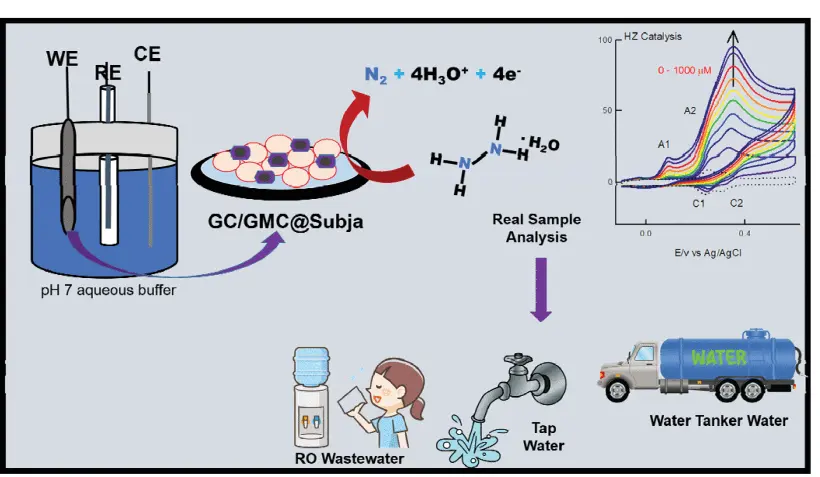
Electrochemical Oxidation of Hydrazine Hydrate Using Subja Seeds–Green Redox Chemistry-Impregnated Carbon-Modified Platform: Harmonizing Sustainable Sensing
The assembly of plant-sourced reactive natural products for a specific heterogeneous catalysis approach has often been carried out without any clear target, using various conventional and electrochemical techniques. The remarkable properties of different plant species are attributed to their unique active molecular components. To address the challenges in this area, this work presents a rudimentary method that combines an electrochemical process with a carbon-based adsorbent to selectively extract a mixture of plant-sourced phytonutrients from Basil seeds (also known as Subja seeds).
This research focuses on a promising area that can provide access to other plant-based systems and fill existing gaps in the field. The current study presents an innovative advancement that utilizes functional electrodes for the on-site extraction and detection of a rutin-rosmarinic acid mixture. The newly developed resilient platform (GC/GMC@Subja) is designed to precisely bind and encapsulate molecularly active redox species derived from plants. This approach enhances the molecule's electroactivity and improves its surface activity, electron conductivity, and overall properties.
Traditional methods for developing sensors involve labor-intensive organic protocols, including synthetic chemistry and subsequent purification. These processes tend to produce costly products with limited commercial availability. The novel research focuses on the greener chemical systems found in the environment, utilizing safer, non-toxic materials and consumer-friendly technologies. It investigates bioactive compounds derived from Subja seeds that serve as natural catalysts and exhibit efficient redox-mediating properties.
While recent studies have reported on the leaves of live plants, identifying a mixture of compounds such as rosmarinic acid, beta-caryophyllene, thymol, carvacrol, and eugenol, which are associated with a holy-plant system, this work reveals the stable and distinct redox characteristics of Subja seeds. This includes detailed chemical information about the signals and their potential electrocatalytic application in real samples.
The researchers reported a well-defined, sharp faradic response with electrode potentials E0' = 0.23 V (A1/C1) and 0.3 V (A2/C2). The model Subja Seeds-Redox (GC/GMC@Subja) has been developed in an aqueous phosphate-buffered solution at pH 7, contributing to a sustainable and resilient strategy. This electrochemical methodology employed a mesoporous carbon framework based on sp2 hybridization to enable π-electron interactions and the adsorption of Subja-Redox, thereby inducing sp3 hybridization.
Additionally, the electrode demonstrates improved oxidative sensing capability for hydrazine (HZ). The electrocatalytic function of GC/GMC@Subja exhibited selective oxidation of hydrazine with a sensitivity of 0.98 μA mM⁻¹ and a detection limit of 1.20 μM (s/n = 3). Furthermore, the proof-of-concept was established through real-sample estimation using a standard-addition approach, yielding a recovery of approximately 101.3%.
This hybrid material, developed by combining eco-friendly redox chemistry derived from Subja seed with carbon-modified electrodes, improves electron-transfer kinetics, electrode conductivity, and the catalytic oxidation of hydrazine, thereby enabling sensitive detection and highlighting how bio-derived components can be integrated with carbon-based electrochemical interfaces to enhance sensing performance. This approach will also reduce reliance on conventional synthetic reagents and support environmentally responsible analytical technology.