




Quasi-Reference Electrode-Integrated Dual-Metal-Gate AlGaN/AlN/GaN HEMT for the Detection of Mercury Ions (Hg2+)
Heavy metal ion toxicity is an escalating global concern, often overlooked due to limited public awareness of its health and environmental impacts. Among these, mercury is particularly dangerous, with exposure linked to neurotoxicity, genotoxicity, kidney damage, immune dysfunction, and even cancer.
Human activities, especially mining and industrial processes, are the primary sources of mercury pollution, releasing it into the air, soil, and water. In soil, elemental mercury is transformed by microbes into the highly toxic methylmercury, whereas in aquatic systems it bioaccumulates through the food chain, making fish a major carrier. Consequently, seafood consumption is the leading pathway of human exposure.
The World Health Organization limits mercury in drinking water to 2 ppb, yet levels near industrial and mining areas frequently exceed this threshold, posing significant health risks. As heavy metals cannot be eliminated from the environment, effective monitoring is essential.
The necessity for regular monitoring has led to the development of portable, cost-effective, and reliable sensors. Conventional detection methods are effective; however, they are expensive and labor-intensive, making widespread monitoring, especially in rural areas, challenging.
To overcome these limitations, researchers have developed field-effect transistor (FET)-based sensors that are compact, portable, and capable of detecting mercury at safe levels. Among these, Aluminum Gallium Nitride (AlGaN)/ Gallium Nitride (GaN) high-electron mobility transistors (HEMTs) are promising due to their sensitivity, selectivity, scalability, and stability in chemical environments.
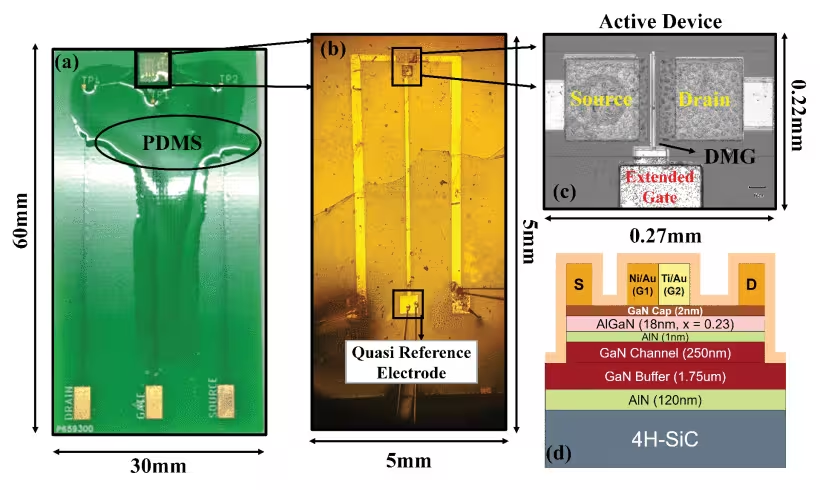
This study proposes a dual-metal gate (DMG) AlGaN/GaN HEMT mercury sensor. The dual metal gate configuration features a high-work-function metal 1 (M1) gate on the source side and a lower-work-function metal 2 (M2) gate on the drain side. The difference in work function between metal M1 and metal M2 enhances carrier injection. It redistributes the electric field near the gate edge on the drain side, thereby improving overall device performance and linearity compared to single-metal gate designs.
Conventional FET-based sensors require an external reference electrode, which complicates integration. The proposed device includes an extended gate electrode that also acts as a quasi-reference electrode. This design shields the main device from damage caused by ionic solutions, thus improving both the consistency and reliability of its performance over time.
To ensure specificity, the sensing pad was functionalized with thioglycolic acid. This molecule forms a self-assembled monolayer on the gold surface and selectively binds Hg²⁺ ions through sulfur–mercury interactions, preventing direct damage to the electrode and enhancing reproducibility.
Here, the influence of gate voltage on sensing performance was studied in detail. A negative gate bias improved sensitivity by attracting mercury ions and reducing noise. At a gate-source voltage of –1 V, the device achieved a maximum drain current sensitivity of 2.64 mA/mm ppb. Tests showed that higher drain voltage made it more sensitive. Some gate leakage increased with mercury levels, but surface coating helped protect the device.
These results confirm the device’s suitability for future mercury ion sensing applications, offering high sensitivity, a low detection limit, and a compact size for measuring trace levels of mercury ions.